Baseline
Remember the empty streets, boarded up stores, and bare shelves of 2020? Something like that appears highly likely, should there not be any major positive developments in the Middle East (which looks quite unlikely).
Luckily, rather than guessing, we can look at hard data and actual numbers:
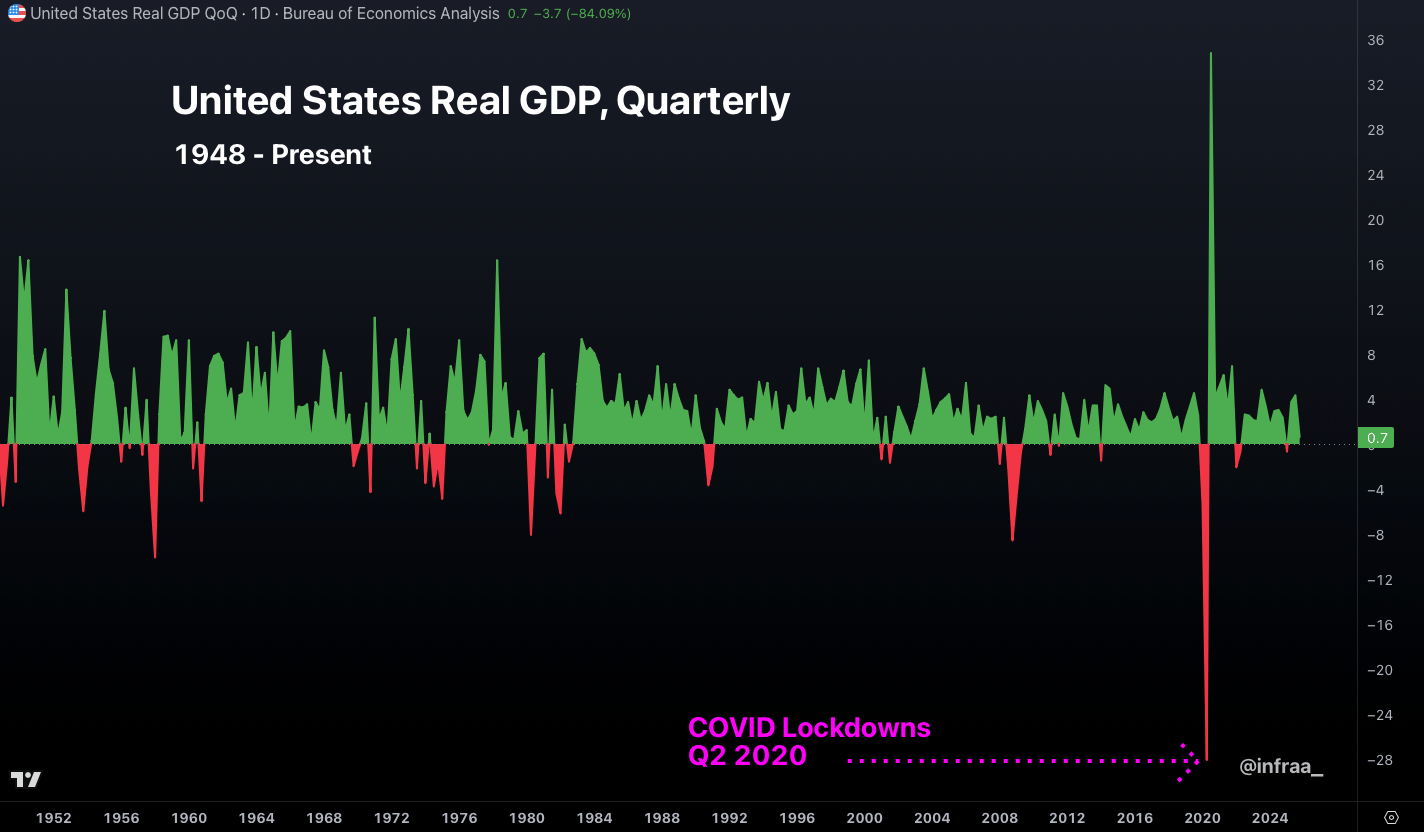
During the 2nd quarter of 2020, the global economy came to a screeching halt. Freeways empty, shipping halted, bare shelves, closed up shops and ‘non-essential worker' lockdowns.
According to the Bureau of Economic Analysis's Q2 2020 GDP print, the US economy shrank by 32%, just in Q2 alone. A third of the US economy- gone.
Because COVID was such a rapid & unexpected shock, there was a huge imbalance between the supply of oil and the demand for it.
This is the sort of economic collapse that was required to destroy the demand for oil. All in all, during Q2 of 2020 (height of the COVID lockdowns), demand for oil fell by 23 million barrels per day (‘bpd').
Given that the clearing mechanism for such an imbalance between supply and demand is price, oil prices famously had to go to -$40 to clear the market.
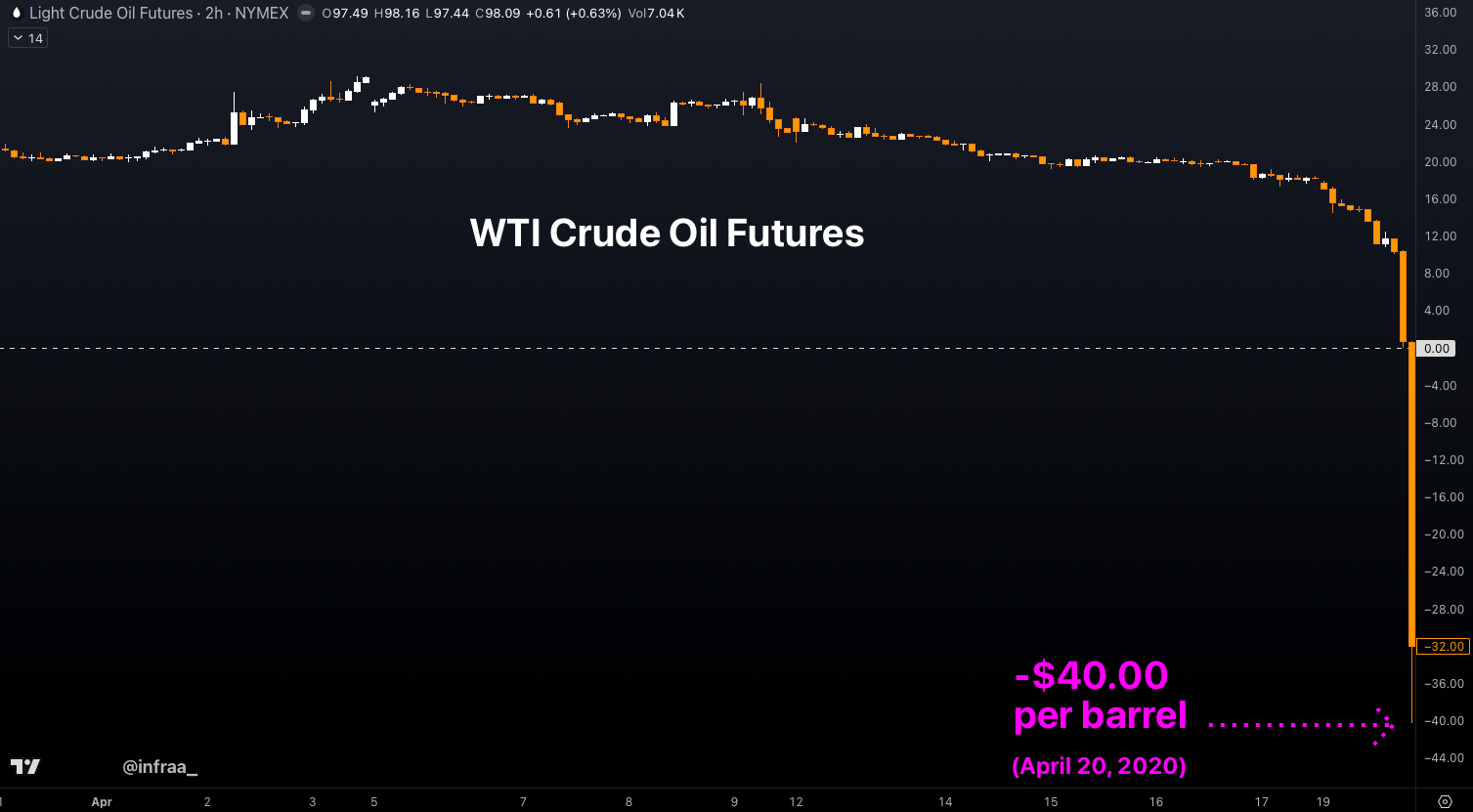
Negative $40 per barrel. That was what was required to clear the 23 million bpd loss of demand due to the global economy screeching to a halt.
So what about today? What's the situation now?
The Strait of Hormuz, which normally carries about 20 million barrels per day of crude oil and products (according to the IEA), is effectively closed. There is no physical blockade (though there may be mines)- but the strait is effectively closed with traffic down 97% and 20 million barrels of oil taken offline.
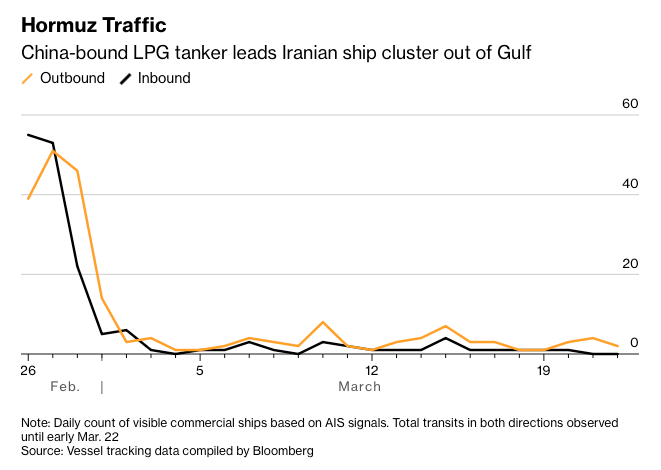
20 million barrels of oil supply were taken offline, just from this one chokepoint. Remember, supply = demand (with prices as the clearing mechanism).
But we didn't just see a supply reduction from the Strait- you need to store oil somewhere. This is called "inventories."
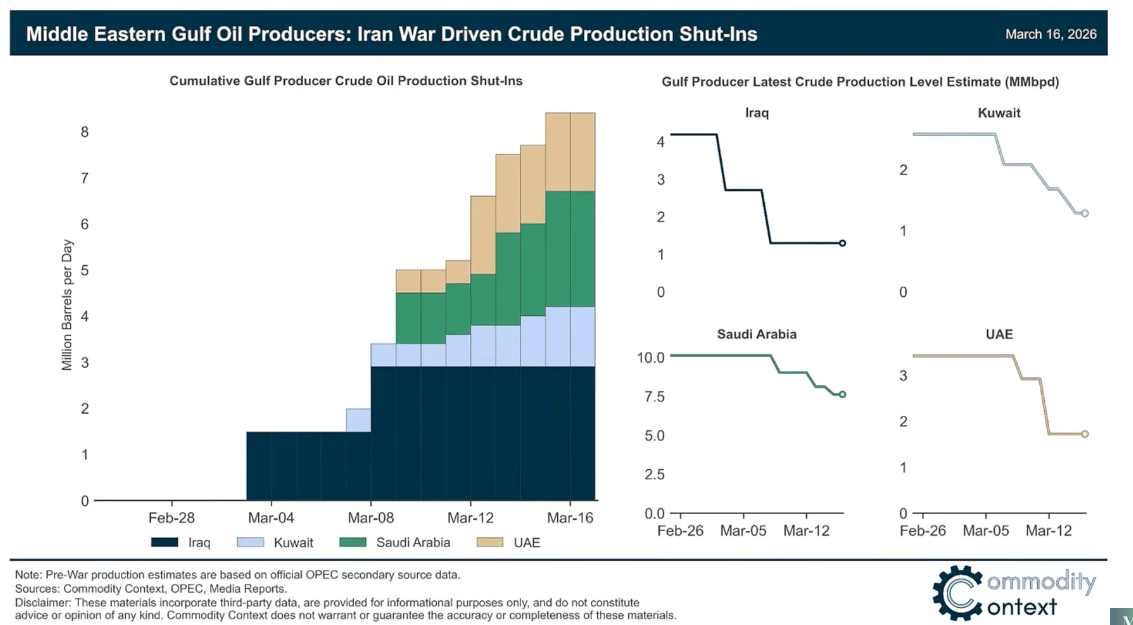
Due to the outbound flow being stopped, refineries started filling inventories. When the tanks fill up, they must stop producing.
"Shut-ins"= 8 million barrels per day.
This will take months/years to bring back.
Not only that, but due to attacks on refineries (from both parties), we're seeing some energy output being taken offline for years.
For example, with just two cheap drones, Iran took 3.5% of global Natural Gas production offline… for FIVE YEARS with their attack on the Qatari refinery.
This current shock is almost identical magnitude as 2020, but reversed. Instead of a -23mln bpd negative demand shock, we're talking about a -20mln bpd supply shock.
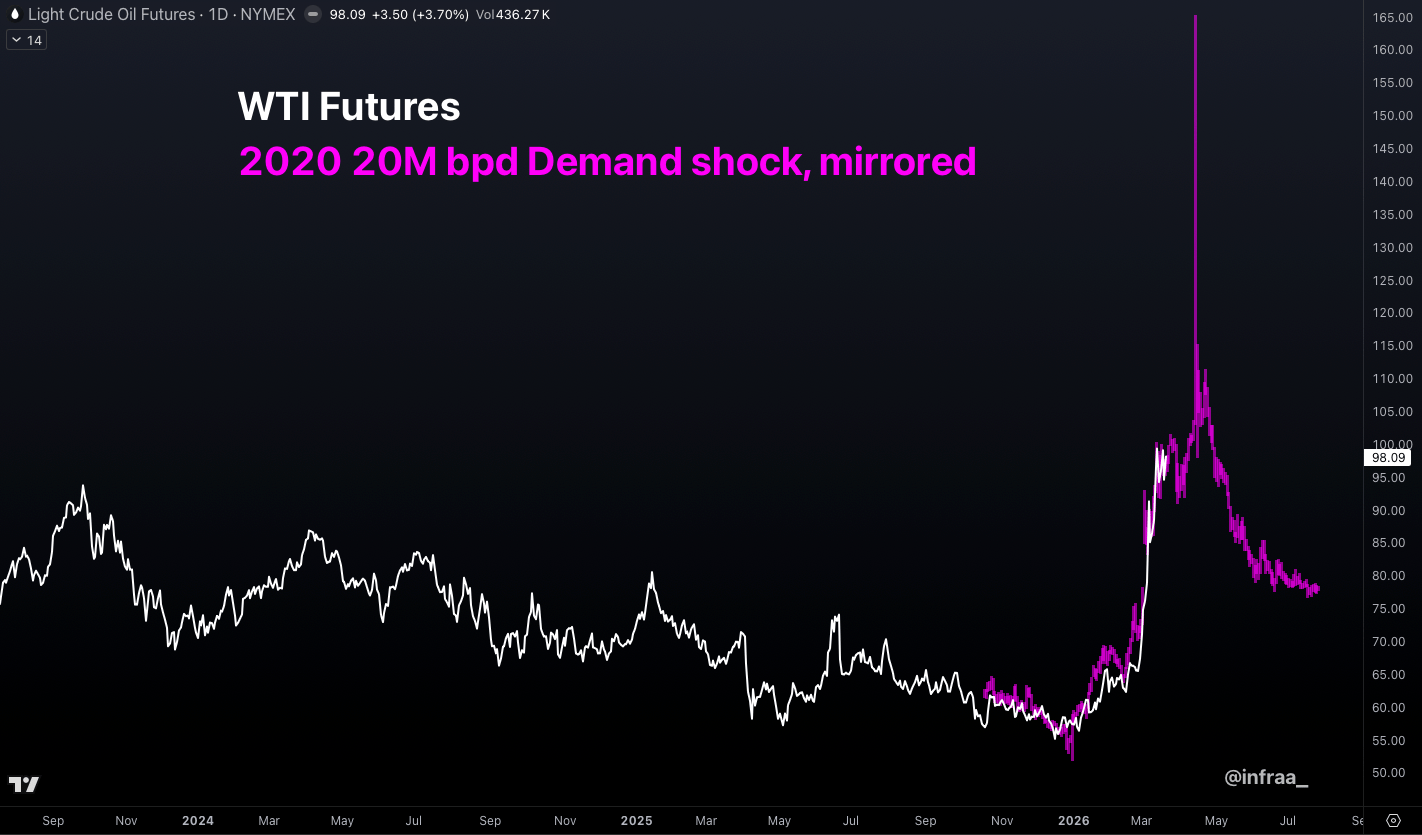
But remember, you can print money to stimulate demand (and that's exactly what we did). But you can’t print oil. Supply must equal demand.
We can’t print more energy, unlike 2020, when we could print $5 trillion to spur demand
This energy is now gone and so too the economic activity predicted on it.
If 20 million barrels per day of supply disappear, something has to give.
Either:
A) The Strait reopens, or
B) Global oil demand (i.e. economic activity) falls by roughly 20 mb/d
C) Find more oil somewhere
The only way demand would fall by 20 mb/d is through a brutal global economic contraction- on the scale of the 2020 COVID lockdowns.
The mechanism is different: prices will spike instead of go negative, but the scale of pain required is roughly comparable-
Demand (economic activity) must be destroyed, and the only way to do that is much higher prices
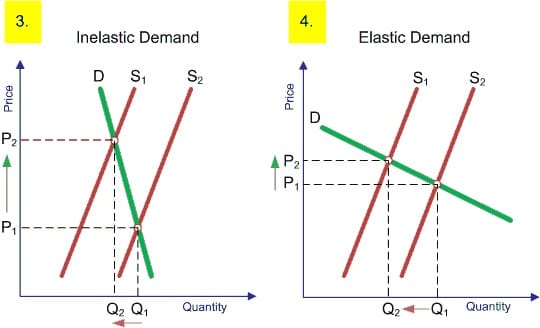
Remember, the price elasticity of demand ("PED") for oil is very low, about 0.1. If oil goes up $10 a barrel, people still need to go to work, get groceries, etc. They don't stop their economic activity (demand), without much higher prices.
Solutions?
This is, by far, the single most catastrophic energy crisis in history and this is why the IEA announced the release of 400mb, but there's a problem:
Flow rate- only about 1.2 million barrels per day can be released from the stockpiles [IEA], and, it's time-limited to just a couple months.
So there's a 1.2 mb/d offset there, but what else can we do?
A Saudi Arabian pipeline can transit oil to Yanbu in the Red Sea, but the flow can only be increased by about 3 million bpd.
Problems:
- Houthis have effectively disrupted this shipping lane as recently as last year (on their own, without direct Iranian attacks)
- Iran just bombed Yanbu 4 days ago & could keep targeting it more aggressively
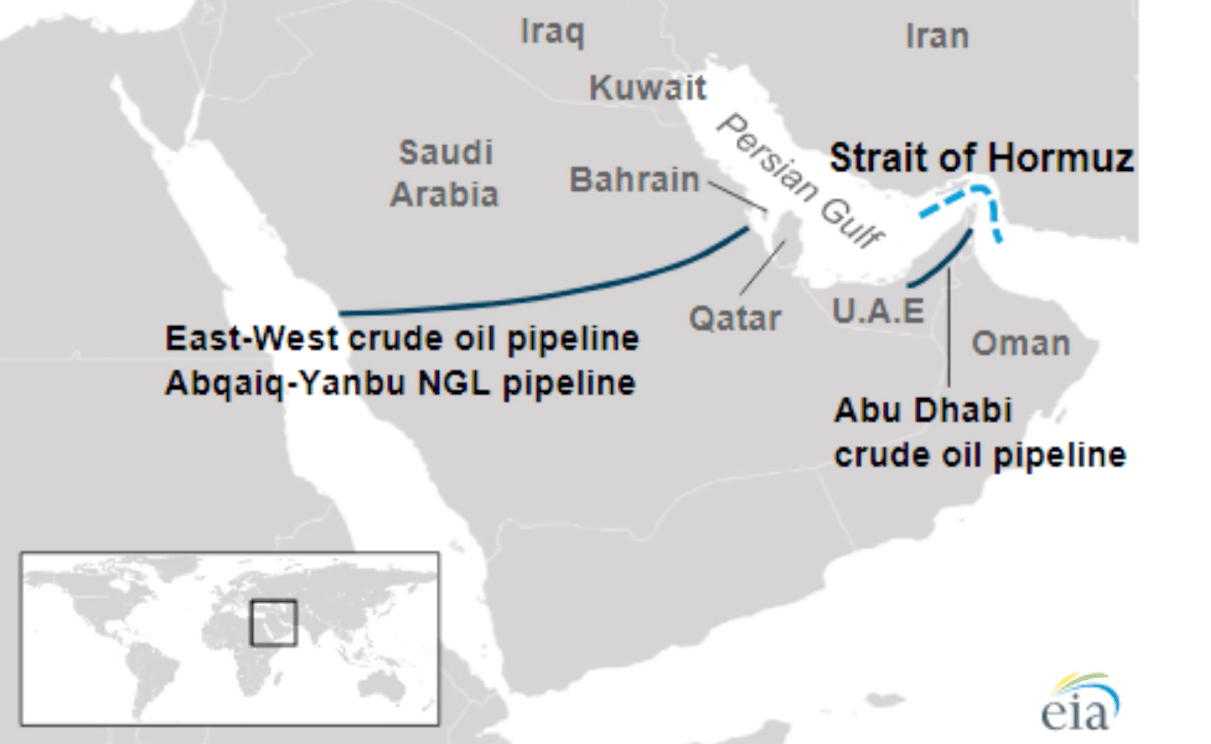
The other offset is a UAE pipeline into the "good" side of the Strait of Hormuz, ending in Fujairah, but this can only be increased by just 0.5 million bpd.
The problem is that Iran has already attacked the terminal in Fujairah and has already taken their operations offline for days. They have proven they have the ability and capacity to do it again.
So far, we're at +4.7 million bpd of offset (to the initial -20 million bpd shock), under the best of circumstances. However, repeated strikes on Yanbu and Fujairah put 3.5 mb/d under serious question.
Even "oil on water", another potential offset, is being tapped at record speed. It’s already down from ~140 million "floating barrels" to ~78 million barrels.
1.8 million bpd (and almost gone). Other than the fact that these "floating barrels" are almost depleted, we've also seen several strikes on tankers in the Mediterranean and Gulf.

So, using the absolutely most optimistic case: we've added +6.5 million bpd to offset the historic -20 million bpd shock.
So an ‘improvement’ from -20mb/d to 13.5mb/d shock
But:
Floating oil = almost gone
SPR = only lasts months
KSA/UAE diversion = repeatedly attacked/offline (half of that 6.5mb)
Even under the most optimistic circumstances, we’re talking about a negative supply shock at least 7x worse than the 2022 Russia/Ukraine war.
This war doesn't just mean higher gas prices-
It means economic activity must collapse by a LOT.
And that happens through MUCH higher prices. $200 Brent oil appears to be a conservative estimate without a dramatic improvement, based on PED of oil (-0.1) and the amount of supply being disrupted.
We should expect volatility on the scale of COVID, as markets wake up to these facts.
Thanks for reading! Catch you in the next one! WANT MORE WOLF? Follow us on YouTube
Benzinga Disclaimer: This article is from an unpaid external contributor. It does not represent Benzinga’s reporting and has not been edited for content or accuracy.
Login to comment