As you know, I'm a seasonal pattern trader to my core. I've spent my 30-plus-year career discovering some of the most profitable patterns in the market.
But it's not just the seasonals that I'm watching.
One of my favorite ways to make safe, passive income is through dividend stocks.
And today, I'm going to share three of my favorite dividend-paying companies in 2026—and how you can potentially double your money or more on each (for a fraction of the cost).
Here are the three dividend stocks to buy now.
Why You Want Dividend Stocks in Your Portfolio
Dividends are the bedrock of every income-lover's portfolio—and for good reason! Beyond immediate cash payouts, these stocks offer investors and traders three major benefits:
- Get More Out of Every Market Move: Dividends historically account for the bulk of the S&P 500's total return. In 2025, for example, they contributed roughly 13% to 16% of that return. And in 2026, that number's projected to grow by 6.5%, keeping cash flowing even when the market isn't.
- Smooth Out the Ride: Companies that pay consistent dividends tend to have steady cash flow and more established business models. That stability can make a difference when markets turn volatile (especially as money rotates into more defensive sectors like Utilities and Consumer Staples).
- Get Paid Twice: Dividend stocks with liquid options chains offer an added edge. With strategies like covered calls, you can collect the income stream while also generating option premiums, helping reduce your cost basis over time.
But of the thousands of dividend-paying companies, there are three sitting in my winner's circle:
| Ticker | Company | Yield | Note |
|---|---|---|---|
| (NYSE:UPS) | United Parcel Service | 6.5% | High yield following recent business pivots |
| (NYSE:EPD) | Enterprise Products | 6.4% | 27 consecutive years of dividend growth |
| (NASDAQ:TROW) | T. Rowe Price | 5.9% | Asset manager with a strong dividend history |
15 Minutes Early Can Change The Trade
When Benzinga Pro breaks exclusive news, members see it before Bloomberg, CNBC, and the public feed. Earnings, FDA approvals, and deal headlines often move fast once they go public. This is how traders position early instead of chasing the crowd. Try Benzinga Pro Free
United Parcel Service

UPS (NYSE:UPS) is one of the largest logistics and delivery companies in the world and plays a key role in global shipping and e-commerce fulfillment.
The stock has been under pressure recently due to rising costs. Higher labor costs and softer domestic volumes remain near-term headwinds. At the same time, Amazon continues to expand its own delivery network, reducing its reliance on UPS.
On top of that, April is historically a weak month. But in the long run, UPS still holds a dominant position in e-commerce logistics—and that demand isn't going anywhere.
In fact, the data shows a turning point in June, followed by a stronger move into the end of the year.
Enterprise Products

Enterprise Products (NYSE:EPD) runs pipelines that move oil and natural gas across the U.S.
The business is built on steady, volume-driven cash flow—not commodity prices. That's a big reason it's been able to consistently pay (and grow) its distribution over time. With U.S. energy production still holding firm, that provides a reliable foundation going forward.
Of course, it's not completely immune. A slowdown in production or broader weakness in energy demand could weigh on volumes.
But this is where EPD stands out. It's one of the most consistent income plays in the space, with a long track record of delivering for investors, even when the markets get rocky.
T. Rowe Price
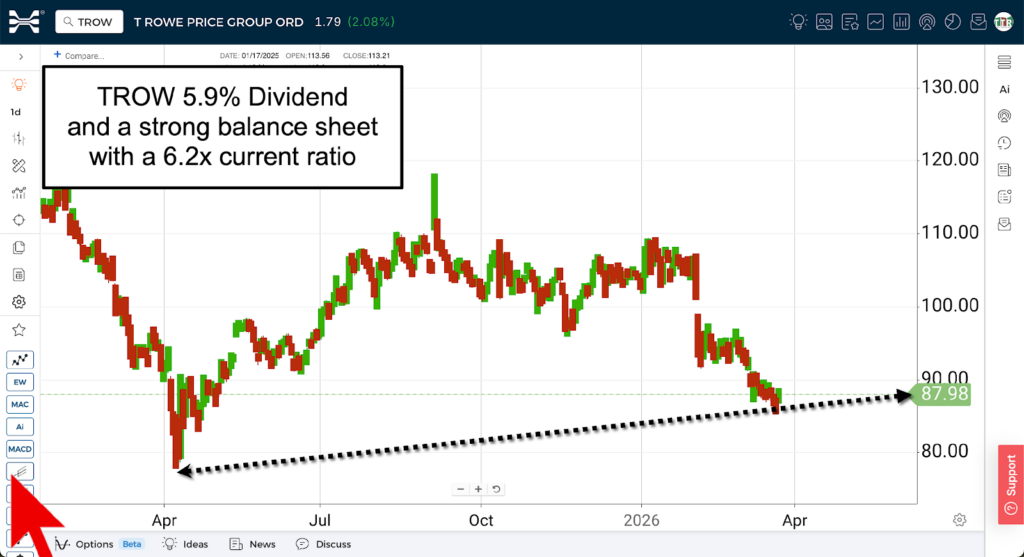
T. Rowe Price (NASDAQ:TROW) is a long-standing global asset manager that oversees investments across mutual funds, retirement accounts, and institutional portfolios.
And like many of its competitors, the stock tends to move with the broader market. So when things get choppy, that can put pressure on assets under management—and the fees tied to them. We've already seen some of that recently, with a bit of short-term weakness.
Despite that, the business remains solid. T. Rowe has a strong balance sheet and is expanding into alternative investments, which could help bring in new client flows over time.
And from a timing standpoint, this is where it gets interesting. While April can be constructive, May and June often bring more sideways action—exactly the kind of environment where income-focused strategies tend to shine.
How to Potentially Double Your Money or More
Selling call options against dividend stocks lets you bring in additional premium. This adds to your overall return while also lowering your break-even price. There is a tradeoff, of course: the stock can get called away.
So let's talk about how it works—and what you could expect to receive using the dividend stocks above.
A covered call is a two-part strategy where you own the underlying stock and “sell” someone else the right to buy it from you at a specific price (the strike price) by a specific date (the expiration).
Think of it like being a landlord: You own the “house” (the stock), and you collect “rent” (the option premium) from a tenant (the option buyer).
To execute this, you must own at least 100 shares of the stock for every one call contract you sell.
- The “Covered” Part: You already own the shares. If the stock moves higher and the buyer decides to exercise the option, you have the shares ready to deliver—so you're not exposed to unlimited risk.
- The “Call” Part: You sell a contract that gives the buyer the right to purchase your shares. In return, you receive cash upfront (this is the premium).
By selling option premium with longer-dated expirations against dividend stocks, like Long-Term Equity Anticipation Securities (LEAPS), you can often collect more in premium than you would from dividends alone.
Here are some examples of at-the-money calls with a January 2027 expiration (plus the expected premiums and projected dividend income:
| Ticker | Stock Price | Annual Dividend | Call Premium | Combined Income | Combined ROI |
| UPS | $97.67 | $6.35 | $8.75 | $15.10 | 15.46% |
| PFE | $26.78 | $1.85 | $2.02 | $3.87 | 14.45% |
| VZ | $50.60 | $3.44 | $3.75 | $7.19 | 14.21% |
| TROW | $87.98 | $5.19 | $6.85 | $12.04 | 13.68% |
| EPD | $38.13 | $2.44 | $1.97 | $4.41 | 11.57% |
Take a look at those combined returns. The broader market averages about 10%-12% a year, without the extra income or built-in cushion.
So, by combining the consistency of high-quality dividend stocks with the upfront premium from long-term covered calls, you're creating an income stream from two different sources at the same time.
And based on my data, you could be looking at a combined return of roughly 11% to 15% on each of these stocks through January 2027, even in this market environment.
Photo: Shutterstock
Login to comment