Something historic is happening in semiconductor ETFs.
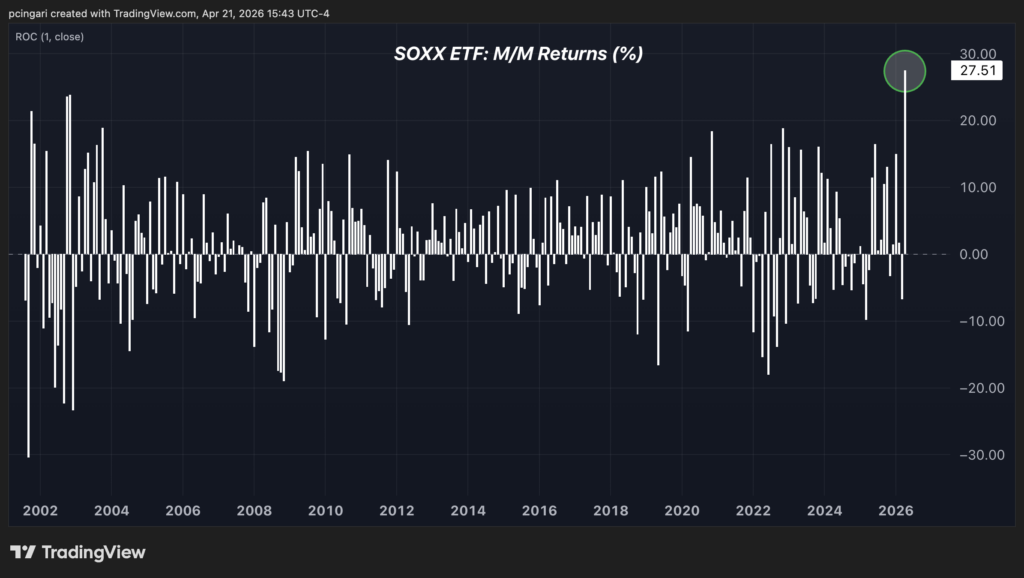
The iShares PHLX SOX Semiconductor Sector Index Fund (NASDAQ:SOXX) has surged 27.7% thus far in April, a move so large it eclipses every monthly return the fund has posted since BlackRock Inc. launched it in July 2001.
The fund also reclaimed all-time highs last seen in late February and saw 12 positive sessions out of 14 this month.
The record is not just about price. Investors are pouring money into chip ETFs at a pace never seen before.
SOXX has absorbed $2.05 billion in April inflows, more than double its previous monthly record. The VanEck Semiconductor ETF (NASDAQ:SMH) has pulled in $3.4 billion, also an all-time high for the fund.
Combined, the two funds have taken in $5.45 billion this month, as per TradingView fund flows data — a single-month flow record for the category.
Chart: SOXX ETF Eyes Best Monthly Performance Ever
The Ceasefire That Unlocked The Chip Trade
To understand the April surge, rewind to the start of the month. The U.S.-Iran war that began on Feb. 28 had closed the Strait of Hormuz, pushed oil above $100, and frozen risk appetite across every technology-adjacent sector.
Chip stocks were particularly exposed.
Then, on April 7, President Donald Trump announced a two-week ceasefire brokered by Pakistan. Markets interpreted the pause as a release valve.
Oil cooled below $90. Risk assets rallied. And semiconductors, which had been the most punished slice of the tech complex during the conflict, snapped back the hardest.
The pain was always going to unwind fast. What surprised some was how much money chased it.
SOXX’s 28.77% April gain leaves behind every prior peak in the fund’s 25-year history. SMH’s 21.91% move is its largest monthly return since November 2003.
What’s The Difference Between SOXX And SMH?
The two ETFs look interchangeable from the outside — both “semiconductor ETFs” with overlapping names. Under the hood, they are built differently, and that architecture is driving the flow split.
As explained by Sumit Roy, senior ETF analyst at ETF.com, the key difference between the iShares PHLX SOX Semiconductor Sector Index Fund and the VanEck Semiconductor ETF lies in the concentration.
SMH tracks the MVIS US Listed Semiconductor 25 Index, a 25-stock basket weighted by modified market capitalization with individual positions capped at 20%.
Nvidia Corp. (NASDAQ:NVDA), whose market capitalization sits around $4.5 trillion, carries a 18.9% weight in the SMH portfolio.
Taiwan Semiconductor Manufacturing Co. (NYSE:TSM) carries roughly 11%. Broadcom Inc. (NASDAQ:AVGO) and Micron Technology Inc. (NASDAQ:MU) follow at above 7% each.
The result is a portfolio that leans hard into the biggest names in the AI hardware stack.
SOXX tracks the NYSE Semiconductor Index, a 30-stock basket with much stricter caps. No constituent can exceed 8%.
Holdings outside the top five are limited to 4%. ADRs are collectively capped at 10%.
Those rules produce a flatter weight distribution. Micron is near 9.5%, Nvidia around 7%, Applied Materials Inc. (NASDAQ:AMAT) and Advanced Micro Devices Inc. (NASDAQ:AMD) each close to 6%.
Taiwan Semiconductor, worth $1.5 trillion, ends up at roughly 4% because of the ADR limit.
The Stocks Driving The Chip Rally
Top April Performers (MTD, as of April 21)
- Astera Labs Inc. (NASDAQ:ALAB) — +79.27%
- Marvell Technology Inc. (NASDAQ:MRVL) — +53.16%
- Intel Corp. (NASDAQ:INTC) — +50.75%
- Monolithic Power Systems Inc. (NASDAQ:MPWR) — +41.36%
- ON Semiconductor Corp. (NASDAQ:ON) — +40.88%
Top YTD Performers
- Teradyne Inc. (NASDAQ:TER) — +97.13%
- Intel Corp. — +80.29%
- Marvell Technology Inc. — +78.52%
- Monolithic Power Systems Inc. — +70.53%
- Arm Holdings plc (NASDAQ:ARM)— +61.12%
Photo: Shutterstock
Login to comment