Five warnings just lit up across the U.S. semiconductor complex in a single week. All five firing together is either unprecedented or has not happened since the dot-com bubble of the early 2000s.
1) The iShares Semiconductor ETF (NASDAQ:SOXX) was up for the eighteenth consecutive session during Friday morning trading – the longest streak ever.
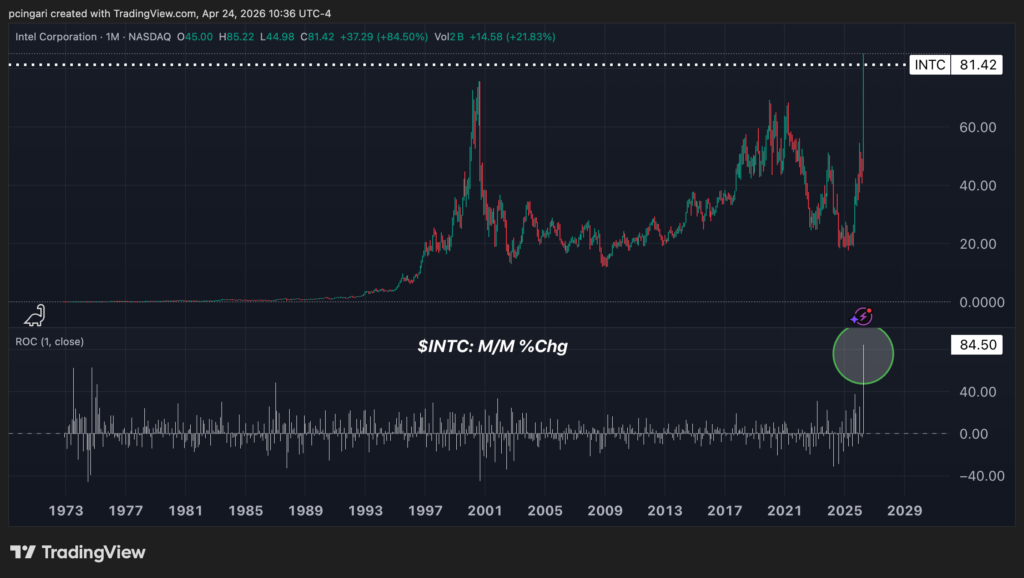
2) Intel Corporation (NASDAQ:INTC) surpassed its prior dot-com all-time high after 26 years.
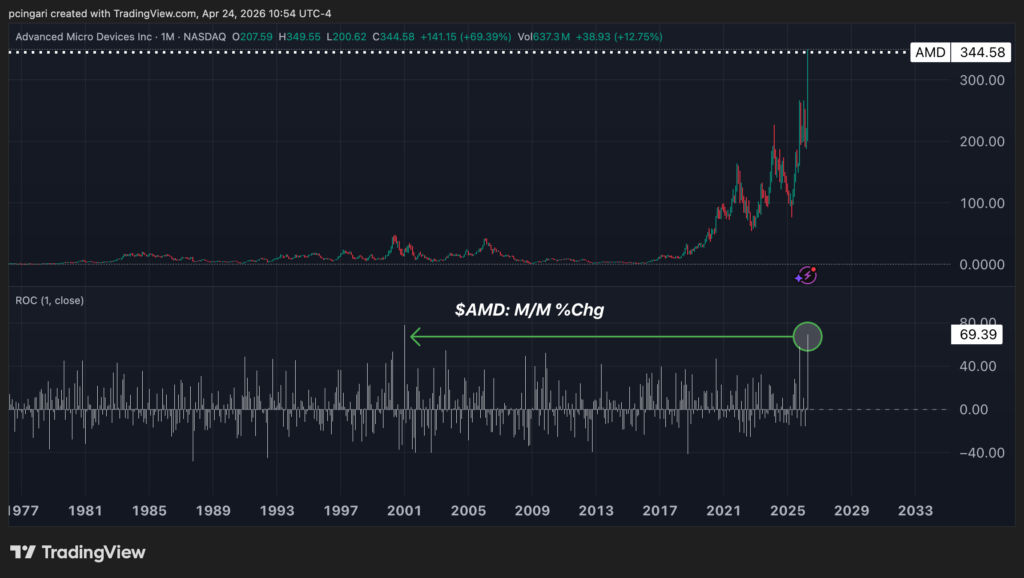
3) Advanced Micro Devices Inc. (NASDAQ:AMD) eyes its biggest monthly gain since January 2001.
4) Micron Technology Inc. (NASDAQ:MU) is on track for its best month since February 2000.
5) Texas Instruments Inc. (NASDAQ:TXN) just delivered its strongest week since December 2000.
Behind each of these extremes sits a real business catalyst.
First-quarter earnings for semiconductor names have been historically strong, Wall Street has upgraded price targets in near-unanimous fashion, and hyperscaler artificial intelligence capital expenditure has accelerated into what analysts now describe as structural rather than cyclical.
The fundamentals are not the problem. The speed of the rally is.
1. SOXX — 18 Sessions Without A Down Day
The iShares Semiconductor ETF, which tracks the 30 largest U.S.-listed semiconductor stocks, closed higher in 18 consecutive sessions through Friday morning trading.
Month-to-date, SOXX is up over 40%, its largest monthly return since the fund’s 2001 inception.
Nothing in the visible dataset matches the current consecutive-close streak.
Bank of America analysts, in a recent outlook note, forecast the 2026 global semiconductor market to reach $1 trillion for the first time.

2. Intel — The Elon Musk Trade
Intel’s move is the most dramatic of the five. The stock closed Thursday at $66.78 and gapped to $85.22 in Friday premarket trading, pushing it above its August 2000 all-time high for the first time in 26 years.
Month-to-date, Intel is up roughly 85%, its largest monthly gain since 1980.
The catalyst is a combination of a blowout first quarter and a strategic partnership with Elon Musk. Intel reported first-quarter adjusted earnings per share of 29 cents, blowing past the 1-cent consensus. Revenue of $13.58 billion beat estimates by more than $1 billion.
Data Center and AI segment revenue grew 22% year-over-year. Intel Foundry revenue rose 16% to $5.4 billion, beating the $4.8 billion Street estimate.
The bigger story was the foundry customer win. Chief Executive Officer Lip-Bu Tan confirmed on the earnings call that Tesla Inc. (NASDAQ:TSLA) and SpaceX will use Intel’s next-generation 14A process node at the Terafab chip complex in Austin, Texas.
Bank of America Securities analyst Vivek Arya raised his Intel price objective to $56 from $48 but reiterated an Underperform rating, arguing the stock is already well-priced.
Stifel had previously upgraded Intel to Buy with a $92 target. Northland also carries a $92 Outperform rating.
The current consensus price target remains roughly $51, well below where the stock trades.
3. AMD — The Meta Trade
AMD is up 67% month-to-date and at an all-time high, on pace for its best month since January 2021.
The catalyst is not an earnings report — AMD does not report until May 5 — but a cascade of institutional validation that began with a 6-gigawatt multi-year partnership with Meta Platforms Inc. (NASDAQ:META) announced in February, followed by steady Street price target increases, positive spillover from Taiwan Semiconductor Manufacturing Company’s (NYSE:TSM) capital-expenditure commentary, and anticipation around the second-half 2026 launch of the MI450 data-center graphics-processing-unit platform.
Analyst rating action has been aggressive. Stifel analyst Ruben Roy raised AMD’s price target to $320 from $280 on April 20, maintaining a Buy rating. Arya raised Bank of America’s target to $310 from $280 on April 18, estimating that every gigawatt of installed AI capacity could generate $15 billion to $20 billion in net revenue for AMD. Bernstein SocGen lifted its target to $265 from $235.
Yet, the consensus price target now sits at $285, or 17% below current prices according to Benzinga data.
4. Micron — The HBM Sell-Out
Micron jumped roughly 47% in April, its biggest monthly gain since February 2001. The structural catalyst is high-bandwidth memory — the specialized DRAM stacks that sit inside every Nvidia Corp. (NASDAQ:NVDA) Blackwell and upcoming Rubin accelerator, and every AMD MI350 and MI450 GPU.
Management disclosed that Micron’s entire 2026 high-bandwidth memory capacity is sold out under binding contracts, including next-generation HBM4 volumes.
Fiscal first-quarter 2026 revenue reached $13.64 billion, up 57% year-over-year, with non-GAAP earnings per share of $4.78 against a $3.94 consensus. The Cloud Memory Business Unit, which houses HBM, delivered $5.28 billion in revenue at a 66% gross margin and a 55% operating margin. Management guided second-quarter revenue to $18.7 billion with gross margins near 68% and record earnings per share of $8.42.
Micron also raised its fiscal 2026 capital expenditure plan to $20 billion, a signal that supply is still not keeping up with demand. Management now projects the HBM total addressable market to expand from $35 billion in 2025 to roughly $100 billion by 2028.
Per Benzinga Analyst Stock Ratings, the consensus price target on Micron now sits at $492.56, indicating that the current prices have already outpaced the median expectations.

5) Texas Instruments — The Industrial-AI Crossover
Texas Instruments jumped 19.4% on Thursday, its third-biggest single-session gain since going public. In more than four decades of trading, the stock has produced a stronger single-session gain on only two days: Oct. 31, 1983, and Oct. 19, 2000.
On a weekly basis, TXN is up more than 20%, its best five-day stretch since December 2000.

The catalyst mixes three threads.
First, data center revenue, which did not even merit a separate disclosure line two years ago, grew about 90% year-over-year in the first quarter.
Second, industrial sales surged more than 30% year-over-year and more than 20% sequentially across all geographies.
Third, Texas Instruments sits at the tail end of a three-year capital-expenditure cycle, meaning free cash flow is about to inflect sharply higher. Trailing twelve-month free cash flow reached $4.4 billion in the first quarter, up from $1.7 billion a year earlier.
The consensus price target on TXN now stands at $256, according to Benzinga data, suggesting the rally has already outpaced Wall Street expectations.
Photo: Shutterstock
Login to comment