Editor’s note: This article was updated to add more details and context.
U.S. economic activity expanded at an annualized rate of 2% in the first quarter, according to the advance estimate released Thursday.
The reading marked an acceleration from the prior 0.5% pace but came in below economists' expectations for a 2.3% expansion.
In a separate release, the Federal Reserve's preferred inflation gauge rose sharply in March, as higher gasoline prices linked to the Iran conflict fed through to broader consumer costs.
The Personal Consumption Expenditures (PCE) price index rose 3.5% year over year last month, up from 2.8% in February and matching expectations.
Core PCE — which strips out food and energy and is closely watched by policymakers — rose 3.2% year over year, accelerating from 3.0% and in line with expectations.
Q1 GDP Missed Forecasts: Here’s Why
The Bureau of Economic Analysis said the first-quarter acceleration reflected upturns in government spending and exports, alongside a pickup in investment, partly offset by a deceleration in consumer spending.
Imports — a subtraction in the GDP calculation — climbed.
Real final sales to private domestic purchasers, the sum of consumer spending and gross private fixed investment that economists watch as the cleanest gauge of underlying demand, increased 2.5% in the quarter, up from 1.8% in the fourth.
Investment was driven by equipment, intellectual property products, and private inventories. Within equipment, the increase was led by information processing equipment, notably computers and peripheral equipment.
Software led the gain in intellectual property. Residential and nonresidential structures both contracted.
Government spending swung positive after a fourth-quarter decline, led by federal nondefense outlays, primarily federal employee compensation.
The BEA noted that the spending pattern was distorted by the government shutdown that occurred in the fourth quarter of 2025.
However, the pricing side of the report ran hot. The gross domestic purchases price index rose 3.6% in the quarter.
The headline PCE price index jumped to 4.5% from 2.9%, and core PCE accelerated to 4.3% from 2.7% — the strongest quarterly reading in over a year, reflecting the pass-through from the energy spike triggered by the Iran conflict and the closure of the Strait of Hormuz in late February.
March PCE Inflation Hits 3.5% As Gasoline Costs Drive Spending Surge
The PCE price index rose 0.7% on the month in March, the hottest monthly print since June 2022, up from 0.4% in February.
On annual basis, the headline PCE rose 3.5% – marking the highest print since May 2023.
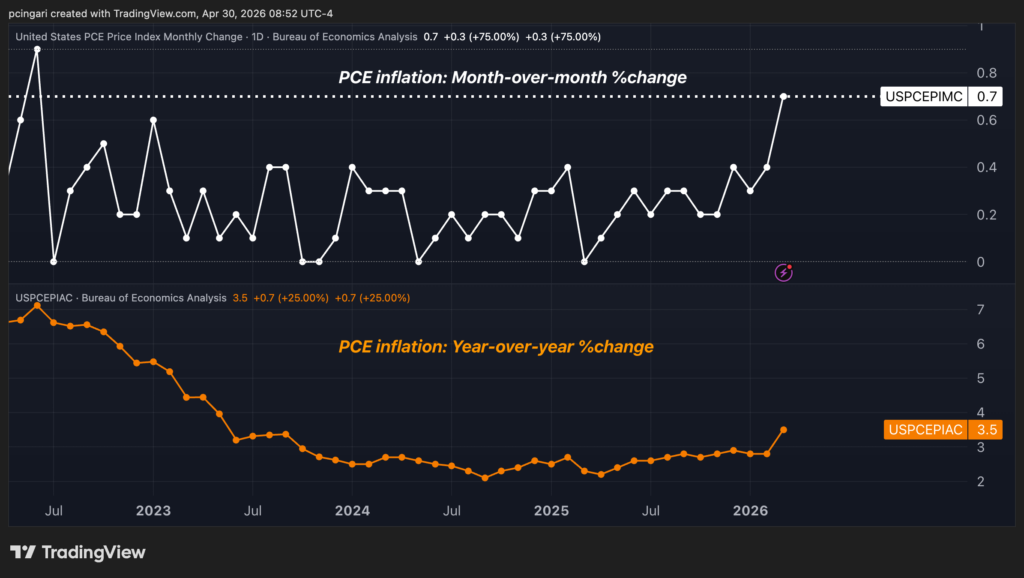
Core PCE rose 0.3%, decelerating from 0.4%. Year-over-year, the Fed’s favorite inflation gauge rose from 3% to 3.2%, matching estimates.
The headline-core gap underscores how much of the inflation impulse came from energy.
Among the categories driving the $195.4 billion monthly increase in nominal consumer spending, gasoline and other energy goods topped the list at $81.3 billion — more than three times the next-largest category, health care at $21.3 billion. Motor vehicles and parts contributed $17.6 billion, financial services and insurance $14.8 billion.
Personal income rose $149.2 billion in March, or 0.6% on the month, after a flat February. Disposable personal income climbed by the same 0.6%. Both readings beat the 0.3% consensus.
Personal spending rose 0.9%, matching consensus and accelerating from 0.6%.
Jobless Claims Plunge To September 2022 Low, Signaling Labor Market Strength
Initial jobless claims fell to 189,000 in the week ended April 25, down 26,000 from the prior week’s 215,000 and well below the 215,000 consensus. The print is the lowest since September 2022 and a 12% week-over-week drop.
The four-week moving average eased to 207,500 from 211,000. Continuing claims dropped to 1.785 million from 1.808 million, also undershooting the 1.82 million consensus.
The labor market data tilts the day’s narrative back toward resilience: layoffs intentions appear minimal and the consumer continues to spend even as inflation reasserts itself.

S&P 500, Nasdaq Rise On Resilient Growth Data Despite Hot Inflation Print
Equities kept pre-market gains on the mix of solid demand and no inflation surprise.
Futures on the S&P 500, tracked by the SPDR S&P 500 ETF Trust (NYSE:SPY), rose 0.49% to 7,170, on pace to test record highs during the session.
The Dow Jones Industrial Average added 0.64% to 49,176, while the Nasdaq 100, tracked by the Invesco QQQ Trust (NASDAQ:QQQ), gained 0.61% to 27,352.
Earnings night split the Magnificent Seven in two. Alphabet Inc. (NASDAQ:GOOGL) climbed over 7% on a blockbuster quarter, while Meta Platforms Inc. (NASDAQ:META) shed more than 8% as capex guidance reignited investor anxiety over AI spending discipline.
Image: Shutterstock
Login to comment