The two largest semiconductor ETFs just printed historic monthly gains.
The iShares Semiconductor ETF (NASDAQ:SOXX) rose 40.4% in April, the largest monthly return in the fund’s 25-year history.
The VanEck Semiconductor ETF (NASDAQ:SMH) rose 32.2%, its best monthly move ever.
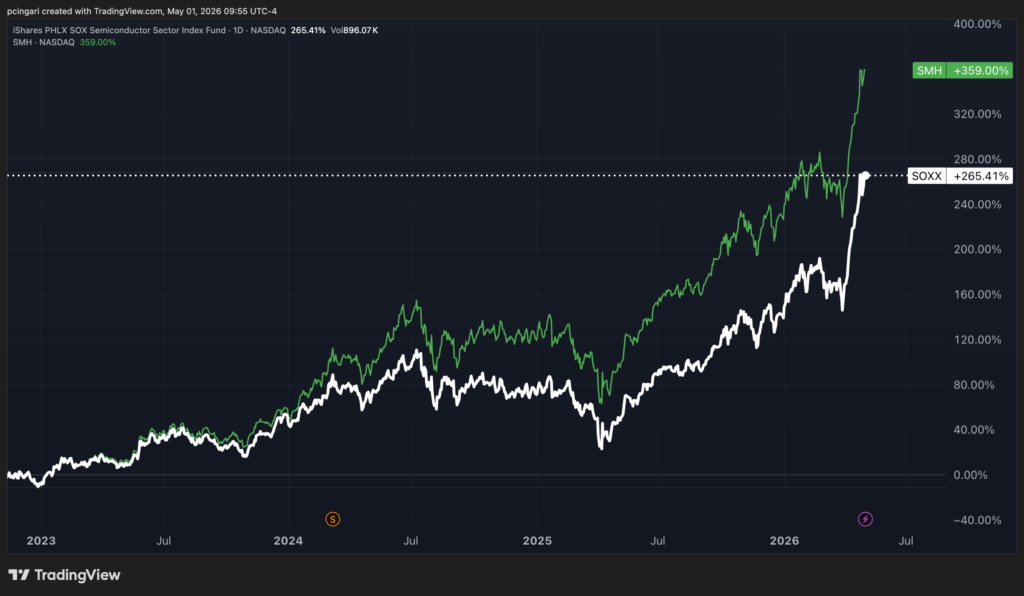
The gap between the two — roughly eight percentage points — is what tells the story of the rally.
• iShares PHLX SOX Semiconductor Sector Index Fund stock is at critical resistance. What’s driving SOXX to record levels?
Both funds hold the same broad universe of U.S.-listed semiconductor companies. Both rallied. But the leadership inside the move was the inverse of what most of 2024 and 2025 had trained investors to expect.
NVIDIA Corp. (NASDAQ:NVDA), the stock that defined the prior phase of the AI trade, was the slowest-moving mega-cap chipmaker in the basket.


The Single Number That Explains The Divergence
Both funds are, on the surface, “semiconductor ETFs” with overlapping names. Under the hood, they are built differently
SMH tracks the MVIS U.S. Listed Semiconductor 25 Index, a 25-stock basket weighted by modified market capitalization with individual positions capped at 20%.
Nvidia, with a market capitalization of around $4.5 trillion, currently carries an 18.1% weight in SMH. Taiwan Semiconductor Manufacturing Co. (NYSE:TSM) sits at roughly 11%. Broadcom Inc. (NASDAQ:AVGO) and Micron Technology Inc. (NASDAQ:MU) follow at around 7% each.
The result is a portfolio that leans hard into the largest names in the AI hardware stack.
SOXX tracks the NYSE Semiconductor Index, a 30-stock basket with much stricter caps. No constituent can exceed 8%. Holdings outside the top five are limited to 4%. ADRs are collectively capped at 10%.
Those rules produce a flatter weight distribution.
Broadcom sits near 7.9%, Micron at 7.8%, AMD at 7.8%, Nvidia at 7.4%, Intel Corp. (NASDAQ:INTC), at 6.5%. Taiwan Semiconductor — a $1.5 trillion company that takes up 11% of SMH — ends up at roughly 4% of SOXX because of the ADR limit.
For most of the past three years, this architecture worked against SOXX. SMH’s heavy NVDA tilt let it ride the single dominant winner of the AI trade. April 2026 reversed the dynamic completely.
Nvidia gained 21.9% on the month — strong by any normal measure, weak by the standards of what every other chipmaker in the basket did.
With Nvidia delivering only a fraction of the move, SMH’s 18% weight to it became a drag, while SOXX’s 7% weight let the broader chip rally come through.
SOXX vs. SMH: Performance Comparison Since November 2022 (“ChatGPT Moment”)
The Chips That Did The Work
The April chipmaker leaderboard is a near-complete inversion of the names that drove semiconductor returns in 2024 and 2025.
Intel — left for dead by most of Wall Street through the prior cycle, with a market cap that had collapsed to a fraction of Nvidia’s — gained 131% on the month after a first-quarter earnings report driven by AI-related chip demand.
Credo Technology Group Holding Ltd. (NASDAQ:CRDO) rose 88%, Astera Labs Inc. (NASDAQ:ALAB) rose 84%, Advanced Micro Devices Inc. (NASDAQ:AMD) gained close to 75% and Marvell Technology Inc. (NASDAQ:MRVL) gained over 64%.
| Company | April Return |
|---|---|
| Intel Corp. | +118.83% |
| Credo Technology Group Holding Ltd. | +88.15% |
| Astera Labs Inc. | +84.11% |
| Advanced Micro Devices Inc. | +74.71% |
| Marvell Technology Inc. | +64.62% |
| ON Semiconductor Corp. (NASDAQ:ON) | +61.71% |
| Micron Technology Inc. | +55.42% |
| NXP Semiconductors N.V. (NASDAQ:NXPI) | +46.44% |
| Texas Instruments Inc. (NASDAQ:TXN) | +43.27% |
| Monolithic Power Systems Inc. (NASDAQ:MPWR) | +42.65% |
Login to comment