Nvidia Corp. (NASDAQ:NVDA) reports first-quarter fiscal 2027 results on May 20, and Goldman Sachs is already looking past the company's jaw-dropping $1 trillion AI revenue target.
The chipmaker has told investors it expects $1 trillion in cumulative revenue from its Blackwell, Blackwell Ultra and Rubin platforms across calendar years 2025 through 2027. But Goldman says investors will be watching for something even bigger: whether that number gets updated higher, and whether other Nvidia products not included in that forecast add even more upside.
In plain English, Goldman is suggesting Nvidia's $1 trillion roadmap may not capture the full scope of the company's AI opportunity.
On Thursday, the Wall Street giant raised its revenue and earnings estimates for Nvidia by roughly 12%, with calendar-year 2026 and 2027 earnings forecasts now sitting 14% and 34% above Street consensus.
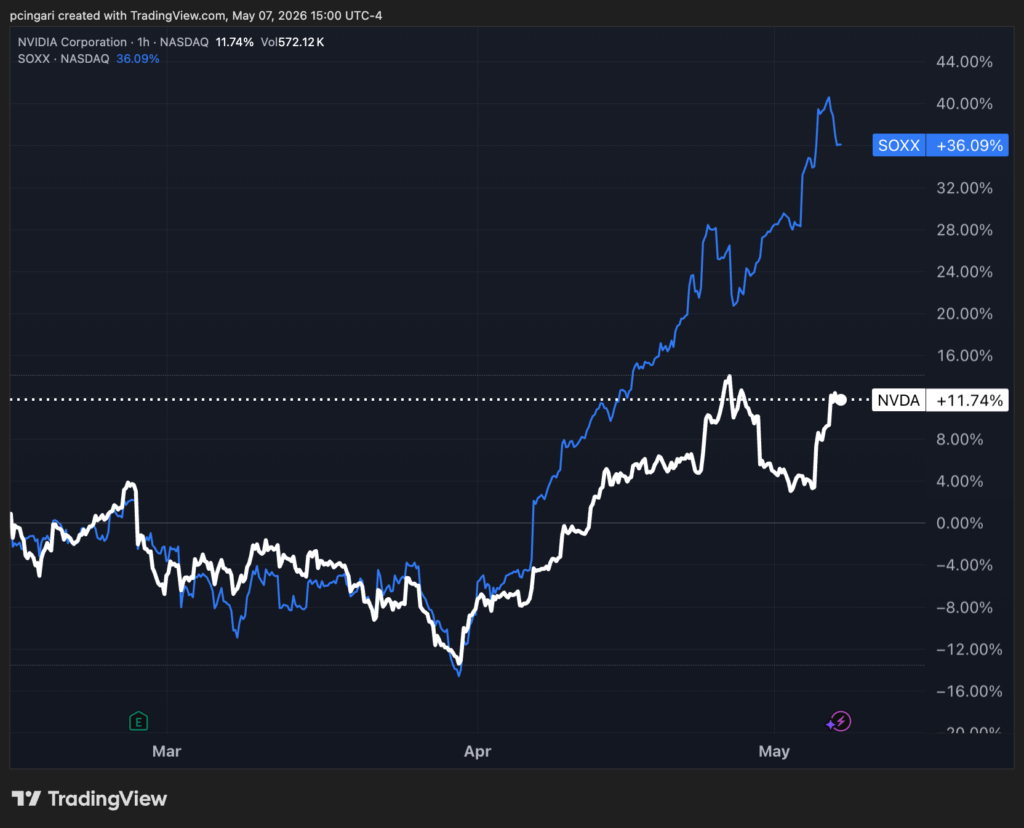
The setup has become its own story. The chipmaker has lagged most of its semiconductor peers this year and now trades at a meaningful discount to its three-year median multiple.
The iShares Semiconductor ETF (NASDAQ:SOXX) has risen by 36% over the past three months, more than three times Nvidia’s returns.
Goldman analyst James Schneider highlighted that the gap can close, but only if management delivers on four specific items investors are watching closely.
“We believe expectations are elevated given strong supply-side results from Taiwan Semiconductor Manufacturing Co. Ltd. (NYSE:TSMC) and the South Korean SK Hynix,” Schneider said.
In addition, U.S. hyperscaler capital expenditure guidance for 2026 has been revised higher.
Nvidia Earnings: What Goldman Expects
Schneider and his team forecast a beat-and-raise quarter for Nvidia.
Their first-quarter revenue estimate of $80.05 billion runs about $2 billion above the Street consensus of $78.30 billion, and their first-quarter earnings estimate of $1.86 per share sits 7% above the $1.74 consensus.
“We expect Nvidia to deliver a roughly $2 billion revenue beat in 1Q, but the bar for stock outperformance is relatively high heading into the print,” Schneider said.
Looking out one quarter further, Goldman sees second-quarter revenue of $87.68 billion against a Street figure of $85.10 billion.
The estimate raise is anchored to commentary management has been delivering since GTC 2026.
Nvidia guided to $1 trillion in cumulative revenue from its Blackwell, Blackwell Ultra and Rubin product platforms across calendar years 2025 through 2027. Goldman expects the print to deliver the first measurable update on whether that number is conservative.
The Four Items That Could Move Nvidia After Earnings
1. The Goldman Question: Is Nvidia's $1 Trillion Target Too Low?
The $1 trillion figure announced at GTC 2026 covers Blackwell, Blackwell Ultra and Rubin only.
That is the key detail behind Goldman's call. The forecast does not include Rubin Ultra, expected in 2027, nor the Vera CPU-only racks scheduled to ship in the second half of 2026 and beyond.
It also excludes inference-tailored configurations such as Rubin-CPX and Groq 3 LPX.
That means Nvidia's headline-grabbing $1 trillion number may not represent the full revenue opportunity investors are trying to value.
"We expect investors to focus on any potential update to this guidance, and incremental upside from other products not included in this guidance," Schneider said.
In other words, investors will not just be asking whether Nvidia can hit $1 trillion. They will be asking whether $1 trillion is already too small.
2. The Agentic AI CPU Opportunity
Agentic AI workloads are driving a different demand profile than training. They require more general-purpose compute alongside accelerators, and Nvidia’s CPU-only racks are timed to that shift.
Goldman wants management commentary on the adoption curve for these systems, what it implies for Nvidia’s overall accelerator market share, and how large the medium-term opportunity is.
The CPU business is currently a rounding error in the Nvidia model. That could change quickly.
3. Demand From Non-Hyperscaler Customers
OpenAI, Anthropic and sovereign AI buyers represent a growing slice of Nvidia’s order book that sits outside the traditional hyperscaler reporting framework.
These customers have been written about extensively but rarely quantified by Nvidia management.
Any tightening of disclosure here would help Wall Street model the durability of demand beyond the four largest US cloud platforms.
4. Margins Under Cost Pressure
Component costs are rising. Memory pricing has reset higher, and the Rubin platform ramps in the second half of 2026 with associated cost dynamics that have not been fully digested by sell-side models.
Goldman expects management to reiterate its mid-70% gross margin guidance for calendar 2026. Any softening of that language would matter more than a revenue beat.
Where The Street Stands
Of 35 analysts tracked by Benzinga, the consensus price target is $274.91, implying roughly 32% upside from the May 6 close of $207.83. The range runs from $210 at the low end to $360 at the high end. Recent rating actions show the upper half of the distribution holding firm.
Benchmark reiterated its Buy on March 31 with a $250 price target.
Rosenblatt maintained Buy at $325 on March 23. Cantor Fitzgerald held its Overweight at $300 on the same day.
The most recent upgrade in the file came from HSBC in October 2025, when the firm raised its rating from Hold to Buy and lifted the price target to $320.
There has been no rating downgrade on Nvidia in the past 12 months.
Image: Shutterstock
Login to comment