Gold has been one of the most talked-about markets in 2026 – and for good reason. After reaching an all-time high of $5,600 per ounce in late January, gold futures entered a deep correction that has lasted more than three months. Here is what the latest data suggests about where gold is headed next.
Price Action: What the Charts Are Saying
The rally that began in Q3 2025 pushed gold futures to historic levels before sellers took control. From the $5,600 peak, the price dropped sharply to $4,402 in early February – a significant retracement. A recovery followed, pushing price back to $5,419 by early March, before another aggressive sell-off drove it down to $4,100.
That second drop was notable for its speed. However, gold found strong support below the yearly open and around the 200 EMA – a key technical level that many institutional traders watch closely. Price has been holding above this level since then.
As of May 28, 2026, gold futures tested the 200 EMA again but failed to reach the previous low of $4,100 – a sign that selling pressure is weakening. Price is currently attempting to reclaim the $4,900 resistance level.
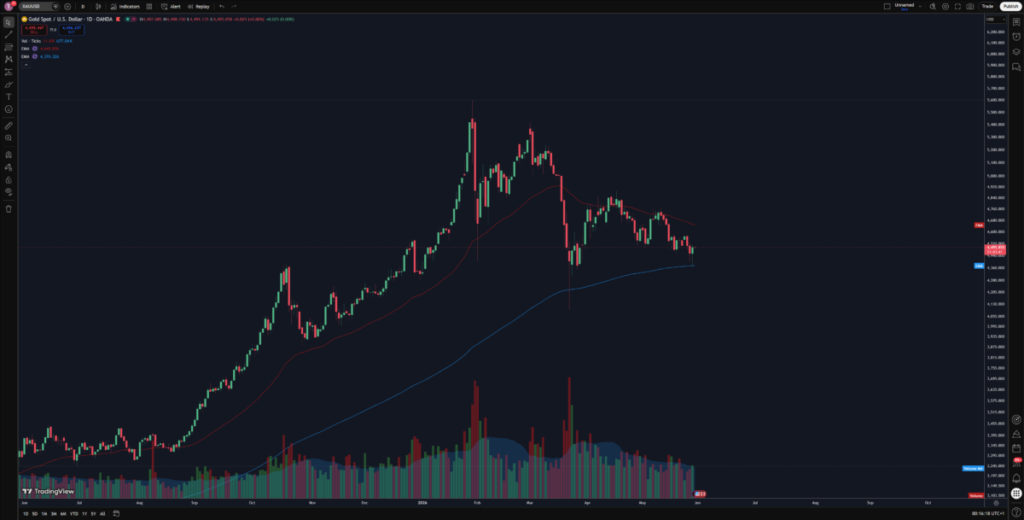
Chart: Created by the author using TradingView.
The Dollar Index: A Key Variable
Traditionally, gold and the US Dollar Index (DXY) have maintained an inverse relationship – when the dollar strengthens, gold tends to fall, and vice versa. However, this relationship has weakened considerably in recent years. Central bank diversification away from the dollar, sustained geopolitical risk premiums, and structural shifts in global reserve demand have all contributed to gold trading more independently of the DXY.
That said, the DXY remains a useful macro backdrop. Since June 2025, it has been ranging between 95 and 100, unable to break decisively in either direction. Dollar softness at the lower end of this range has historically provided a tailwind for gold – but given the decoupling seen in recent months, DXY movement alone is unlikely to be the primary driver. Traders should weigh it alongside positioning data and geopolitical developments rather than relying on it as a standalone signal.
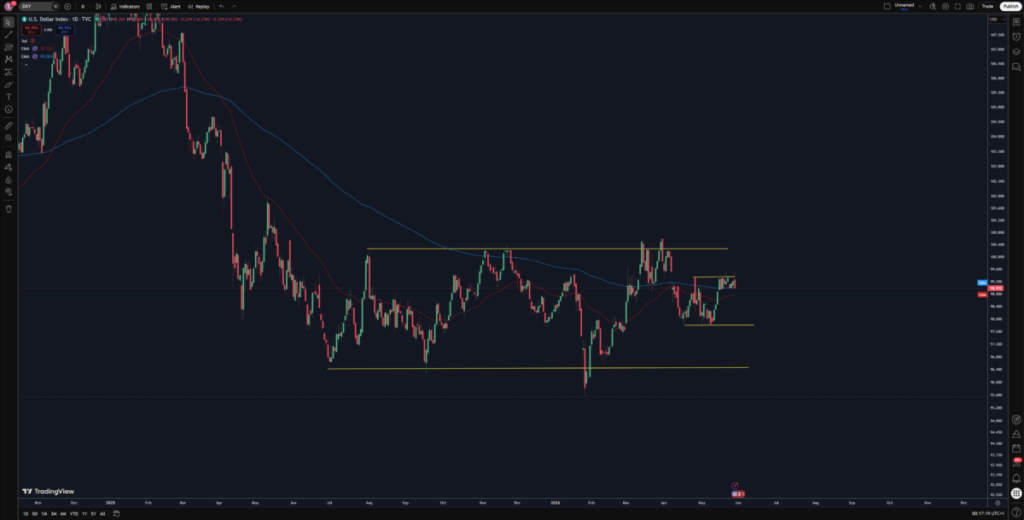
Chart: Created by the author using TradingView.
What Institutions Are Doing: The COT Report
The Commitment of Traders (COT) report – published on May 19, 2026 – shows swap dealers adding long positions and closing shorts on gold futures. This is worth noting. Large institutions never fill their entire position at once – doing so would move the market against them. Instead, they build positions gradually over time. The current COT data suggests accumulation may be underway, even if a clear buy signal has not yet been confirmed.
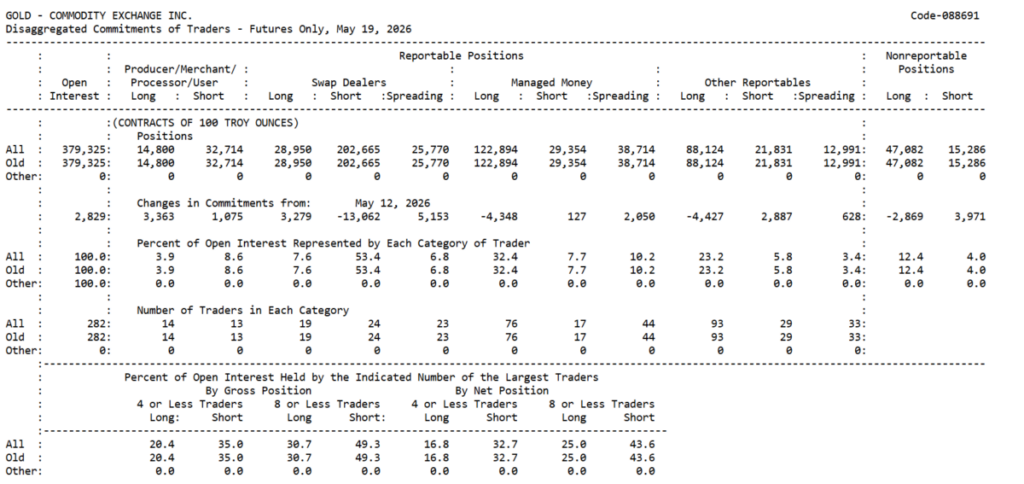
Screenshot: Taken from the CFTC website by the author.
The US-Iran Ceasefire: A Geopolitical Tailwind
The conflict between the US and Iran sent oil prices – including West Texas Intermediate Crude (NYMEX: CL) – surging and added a significant risk premium to gold. A 60-day ceasefire agreement has now been reached, pending approval from President Trump. The reopening of the Strait of Hormuz reduces one of the key geopolitical risks that had been supporting gold's safe-haven demand – but institutional positioning suggests the broader bullish trend remains intact.
Key Levels to Watch
At the time of writing, gold futures are trading at $4,513 per ounce after a strong rejection from $4,370. Two scenarios are in play:
- Bullish case: Price breaks above $4,580 and rallies toward the $4,900 resistance zone. A DXY pullback toward 95 could extend that move above $5,000.
- Bearish case: Price fails to clear $4,580, sellers regain control, and the correction extends further.
With institutions building long positions and geopolitical pressure easing, the path of least resistance for gold futures appears to be higher – but confirmation above $4,580 is the key trigger to watch.
Image Credits: All charts and screenshot in this article were created by the author.
Benzinga Disclaimer: This article is from an unpaid external contributor. It does not represent Benzinga’s reporting and has not been edited for content or accuracy.
Login to comment