The U.S. economy is increasingly dividing into two distinct realities, with affluent Americans fueling a luxury boom while lower- and middle-income households face mounting financial pressure.
Fractured Landscape: ‘E’ Shaped Economy
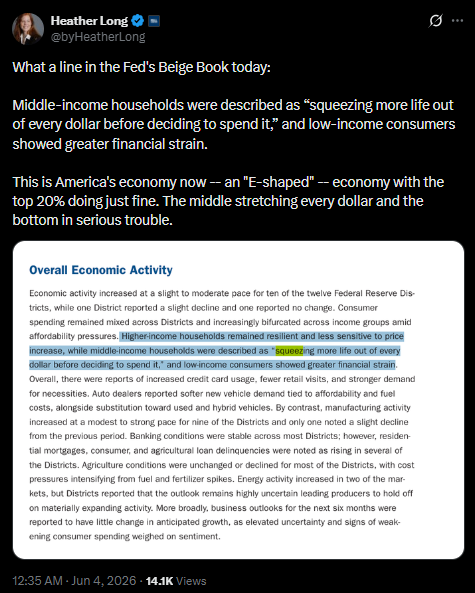
The Federal Reserve's latest Beige Book report highlights a stark bifurcation across income brackets amid persistent affordability pressures. While higher-income households have remained resilient and relatively insensitive to price increases, the rest of the country is pulling back.
According to the report, middle-income households were widely described as “squeezing more life out of every dollar before deciding to spend it,” while low-income consumers showed signs of much greater financial strain.
Heather Long, Chief Economist at Navy Federal Credit Union, characterized the current dynamic as a classic “E-shaped” economy, noting that the top 20% are doing fine while the middle class is stretching every dollar and the bottom is in serious trouble.
Rising Business Strain
As discretionary spending slows, consumer-facing companies are feeling the pinch. Non-labor input costs and fuel spikes linked to global geopolitical tensions continue to rise faster than selling prices, driving widespread concerns about corporate margin compression.
Jeffrey Roach, Chief Economist for LPL Financial, told Benzinga that we may be at an economic crossroads as credit conditions appear to be weakening. To cope, many “firms are temporarily absorbing higher input costs to preserve customer demand,” Roach observed.
This margin-eating strategy typically occurs when businesses collectively realize that the average American consumer is on weaker footing.
Tepid Economic Outlook
Outside of specialized growth sectors like data center construction and defense spending, the broader labor market has settled into a quiet, low-hire, low-fire environment. Workers are increasingly reluctant to risk leaving stable jobs due to macroeconomic uncertainty.
While business investment is expected to sustain a modest 1.8% annualized growth rate for the second quarter, rising delinquencies in auto loans, credit cards, and mortgages signal that the consumer bedrock is becoming increasingly fragile.
How Have Markets Performed In 2026?
The S&P 500 index has advanced 10.14% year-to-date. Similarly, the Nasdaq Composite index was up 15.57%, and the Dow Jones gained 4.76% YTD.
The SPDR S&P 500 ETF Trust (NYSE:SPY) and Invesco QQQ Trust ETF (NASDAQ:QQQ), which track the S&P 500 and Nasdaq 100, respectively, closed lower on Wednesday. The SPY ended down 0.70% at $754.24, while the QQQ was lower by 0.26% to $744.21.
Meanwhile, Dow tracker, State Street SPDR Dow Jones Industrial Average ETF Trust (NYSE:DIA), closed 1.13% lower on Wednesday.
Disclaimer: This content was partially produced with the help of AI tools and was reviewed and published by Benzinga editors.
Photo courtesy: Shutterstock
Login to comment