Kura Oncology, Inc. (NASDAQ:KURA) and Kyowa Kirin Co., Ltd. (TSE: 4151, "Kyowa Kirin") today announced encouraging long-term results from the Phase 1/2 KOMET-007 single-arm trial (NCT05735184) evaluating ziftomenib in combination with intensive chemotherapy, 7+3, in newly diagnosed NPM1-m or KMT2A-r AML. These results will be presented at the European Hematology Association 2026 Congress.
These data compare favorably to historical standard-of-care data with 7+3 alone:
| NPM1-m Patients | KOMET-0071 | Historical 7+3 Benchmark | |
| CR Age ≤ 65 years Age > 65 years | 91% (31/34) 100% (15/15) | 88%2 56%2 | |
| CRc | 96% | 56-89%2,3,4 | |
| CR MRD- (bone marrow) | 56% | 44%5 | |
| 12-month OS rate | 94% | ~ 70-80% in younger fit patients3,4,5 ~ 45-55% in patients > 65 years old2,6 | |
1KOMET-007 (N=49) at 600 mg ziftomenib; MRD neg < 10-4; 2Lachowiez et al., Blood Adv. 2020; 4(7): 1311–1320; 3Hernández-Sánchez et al., Leukemia. 2026; 40(2): 418-428; 4Othus et al. Leukemia. 2019; 33(2):371-378; 5Othman et al., Blood. 2024; 144(7):714-728, including Supplemental Material; 6Recher et al., Leukemia. 2022; 36(4): 913-922.
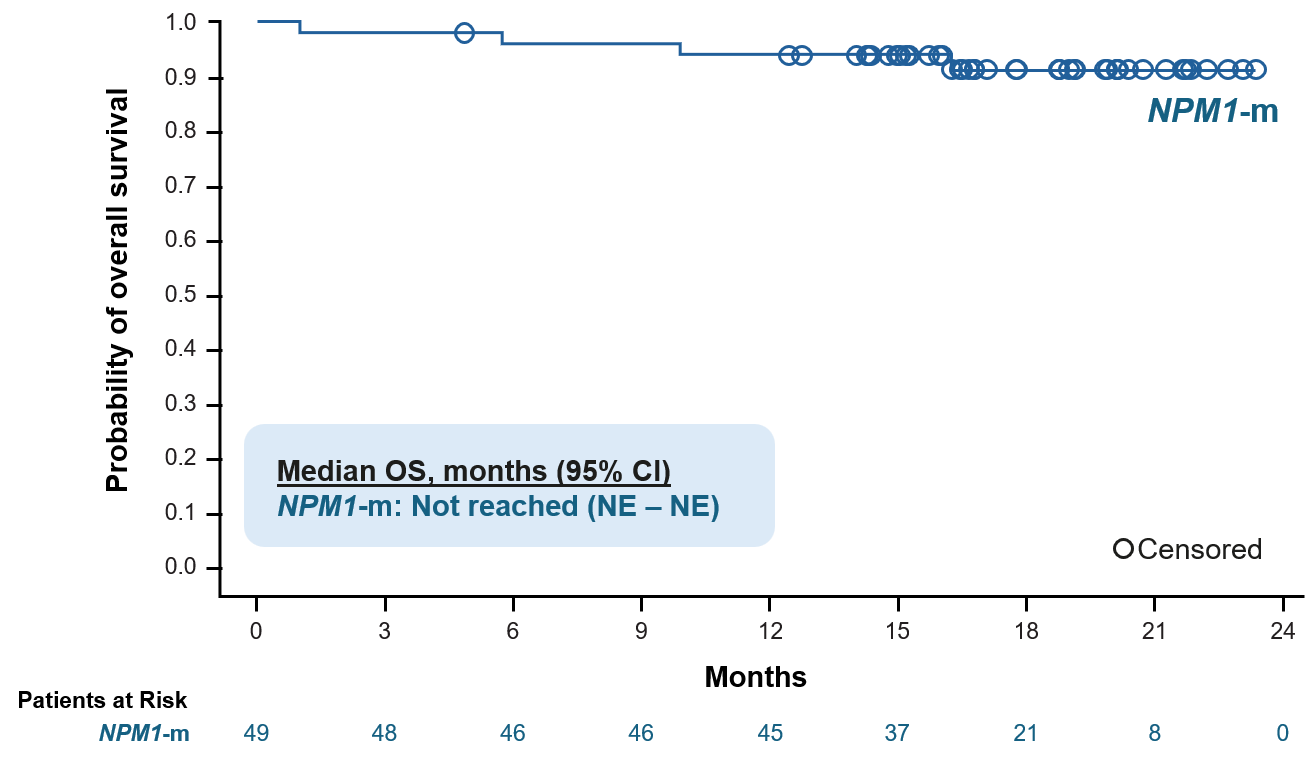
Overall Survival (OS) for NPM1-m Patient Subset in Single-Arm KOMET-007 Trial: Median OS Not Reached
KOMZIFTI™ (ziftomenib) is approved by the U.S. Food and Drug Administration (FDA) as monotherapy for adult patients with relapsed or refractory AML with a susceptible NPM1 mutation who have no satisfactory alternative treatment options. The use of ziftomenib in combination with 7+3 is investigational and has not been approved by any health authority.
"The updated results from the KOMET-007 trial provide important evidence supporting the safety and clinical activity of adding ziftomenib to intensive chemotherapy for patients with newly diagnosed NPM1-m and KMT2A-r AML," said Amer Zeidan, M.B.B.S., M.H.S., Chief, Division of Hematologic Malignancies at Yale Cancer Center and Professor of Medicine at Yale School of Medicine, and the lead investigator for the registrational KOMET-017 program. "Across nearly 100 patients treated to date, composite remission rates reaching 90-96%, high rates of MRD negativity and encouraging durability are especially meaningful in a disease where depth of response can inform long-term treatment decisions. The 12-month survival estimate of 94% for the NPM1-m patient cohort is particularly impressive. Based on the results observed to date, this regimen could represent a transformative therapeutic approach and may allow some patients to avoid allogeneic hematopoietic cell transplantation, a procedure that carries a significant risk of mortality and morbidity. We will continue to follow patients to assess long-term safety and clinical activity, including outcomes for those who do not undergo transplantation, and these results continue to strongly support the registrational Phase 3 KOMET-017 trials."
As of the data cut-off on April 10, 2026:
High remission rates across both molecular subtypes
- 96% CRc and 98% ORR in NPM1-m AML, 90% CRc and 92% ORR in KMT2A-r AML
Deep molecular responses, including marrow central MRD assessment
- Local CRc MRD-negativity rates were 85% in NPM1-m AML and 82% in KMT2A-r AML
- In NPM1-m AML, marrow central MRD negativity (10-4, NGS) among CRc responders was 79% (31/39) at the <0.1% threshold and 56% (22/39) at the <0.01% threshold, with all CRc responders who achieved central MRD negativity doing so by Cycle 2
Durable responses and encouraging durability with extended follow-up
- After median follow-up of nearly 18 months (range 1.0-23.5) in NPM1-m AML and 11.0 months (range 0.9-21.9) in KMT2A-r AML, median duration of complete response was not reached for the NPM1-m AML cohort and was 12 months for the KMT2A-r AML cohort
- Median OS was not reached, with median follow-up of 17.6 months in NPM1-m and 11.0 in KMT2A-r, respectively
- NPM1-m: 94% OS rate at 12 months (range 1.0-23.5)
- KMT2A-r: 71% OS rate at 12 months (range 0.9-21.9)
- The majority of patients remained alive and continued on study at time of data cut-off:
- NPM1-m: 90% (44/49)
- KMT2A-r: 62% (31/50)
Consistent and manageable safety profile
- Ziftomenib 600 mg once-daily plus 7+3 was generally well tolerated, with no new or unexpected safety signals observed with longer follow-up
- Low rates of ziftomenib-related cytopenias and minimal additive myelosuppression were observed with this combination
- Ziftomenib 600 mg once-daily did not delay neutrophil or platelet count recovery
- No Grade 4 differentiation syndrome or QTc prolongation events were reported
- Four patients (4%) experienced Grade 3 differentiation syndrome; all cases successfully resolved with protocol-specified mitigation and three continued on ziftomenib treatment
- Three patients (3%) experienced Grade 3 investigator-assessed QTc prolongation (all three on azole antifungals, fluoroquinolones, or other medications at time of assessment; one with ongoing hypokalemia and hypomagnesemia); none were assessed as ziftomenib-related and all QTc events successfully resolved with all patients continuing on ziftomenib treatment
- 60-day mortality rate of 2% (1/49) in NPM1-m patients
Login to comment