The tech sector continues to race ahead of its market peers, especially now that there appears to be an agreement to end the Iran war. But one former tech proxy apparently isn't ready to join in on the fun.
Cryptocurrency markets have struggled following Bitcoin's latest all-time high in October, and several ‘risk on' macro events have failed to move digital assets out of the doldrums.
Additionally, some cracks are beginning to appear within individual companies, especially those operating under the Bitcoin treasury model.
Today, we'll look at five crypto-related tech stocks that the market is leaving behind, and dig deep to see if any of them have reason for optimism as crypto winter descends.
Strategy Inc.
Bitcoin treasury firm Strategy (NASDAQ:MSTR) (formerly MicroStrategy) broke a long-standing promise earlier this spring. It sold Bitcoin for the first time in years, selling 32 tokens to meet dividend obligations on its preferred shares.
Selling 32 tokens is a rounding error on the balance sheet for a company that holds more than 800,000 BTC, but it was more about what the sale signified than its effects on the bottom line.
Strategy's model depends on its shares trading at a premium to its Bitcoin holdings, so it can continue issuing common stock and preferreds to buy more Bitcoin. That premium is narrowing quickly, and with BTC trading around $65,000, the company's aggregate holdings are now underwater (average price approximately $75,000).
The stock caught a bid during the brief crypto rally in April, but that rally has since faded while broader markets continue to rise. MSTR shares failed to break out after briefly surpassing the 50-day moving average, and now the stock is flashing bearish signals across multiple technical tools, including a heavily bearish Moving Average Convergence Divergence (MACD) indicator.
SharpLink Inc.
SharpLink (NASDAQ:SBET) attempted to apply Strategy's techniques to Ethereum. The company abandoned its gaming platform to acquire ETH, quickly becoming the second-largest holder of the second-largest cryptocurrency.
But unlike Strategy, SharpLink's success with the digital asset treasury (DAT) was fleeting, and the stock has quickly erased most of its value. SharpLink's stockholders are heavily diluted thanks to more than $3.2 billion in equity raises to buy ETH, and the company doesn't have enough cash (less than $17 million) to fund purchases without issuing more equity.
Losses are starting to pile up; the company lost $734 million in fiscal 2025 and reported another $685 million loss in Q1 2026.
Operational deficiencies have bled into stock performance, and SBET shares are down more than 45% over the last 12 months (and more than 90% from the May 2025 peak). Investors eyeing a rebound might have to wait a while. The MACD and Relative Strength Index (RSI) both indicate sellers are in total control, and the share price is facing stiff resistance at the 50-day moving average.
Coinbase Global Inc.
Coinbase (NASDAQ:COIN) is the largest publicly traded crypto exchange on U.S. markets, and its stock has become a proxy for the health of the overall crypto market. Coinbase makes an overwhelming majority of its sales from trading fees, so when trading volume dries up, so does Coinbase’s revenue. And the current picture isn't looking bright.
Q1 2026 was a nightmare quarter with a net loss of nearly $400 million and a massive EPS miss ($1.49 loss per share vs. $0.29 expected). Crypto trading volumes are down 40% year-over-year (YoY), and the company's other revenue streams (prediction markets, subscription fees) simply don't come close to making up the difference.
COIN shares are near a 52-week low and appear stuck in a trading range that began in February. Despite the flat trading since February, the RSI and MACD have both shown momentum fraying even further, and unless crypto stages a roaring second-half rally, COIN shares might have lower lows in store for investors.
Riot Platforms Inc.
Our first ‘sell the rip’ candidate on the list is Bitcoin miner Riot Platforms (NASDAQ:RIOT), which has gained 120% YTD despite a total collapse in Q1 adjusted EBITDA (from $463 million to just $13 million).
An earnings decline of this magnitude, despite record revenue, is definitely a red flag, and the stock's performance this year is already baking in a successful pivot from Bitcoin miner to AI data center landlord. But data center revenue is a tiny portion of Riot's overall sales, and the stock trades at 16 times sales, with short interest approaching 20%.
RIOT shares have enjoyed an exponential breakout this year, but the entire thesis rests on a successful business model shift for a company already known as a low-efficiency minor.
The data center pivot requires significant infrastructure retrofitting and 24/7 power, and the stock's current valuation is pricing in perfect execution.
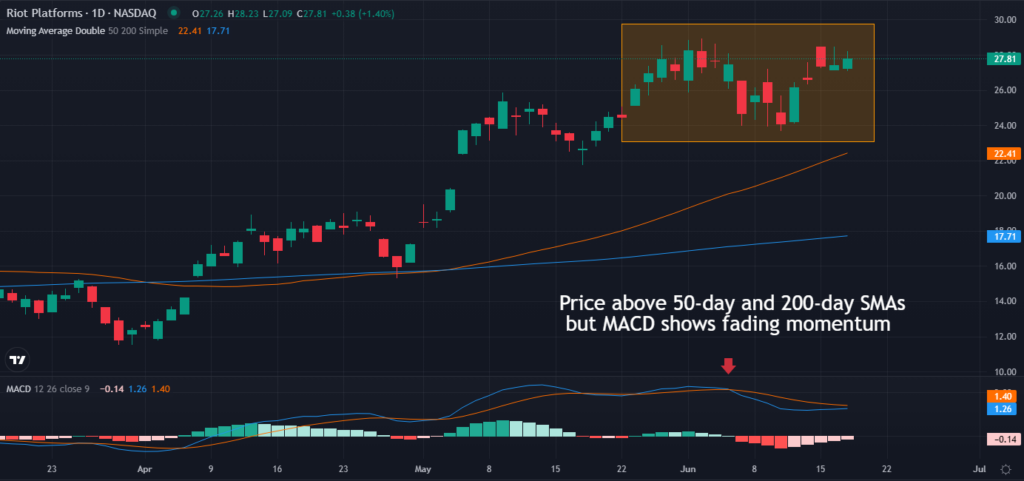
The technical picture is similar: RIOT's stock price is above the 50-day and 200-day moving averages, but the MACD is flashing bearish signals for the first time since April.
Mara Holdings Inc.
Mara Holdings (NASDAQ:MARA) is another Bitcoin miner attempting to wedge itself into the data center industry. But unlike Riot, Mara Holdings' energy expenses are holding back the company from fully jumping into the AI waters.
Energy expenses accounted for approximately 80% of gross revenue in 2025, as declining Bitcoin prices supercharged per-coin production costs.
The stock has jumped more than 50% so far in 2026 as Mara has inked three deals (Long Ridge, Starwood Digital, Exaion), but it remains down over the last 12 months and has been cut in half over the last five years.

Many companies are attempting to convert from Bitcoin miners to AI data center plays because of their existing power infrastructure, but MARA has been more aggressive than its peers in using M&A and leverage to fund its buildout.
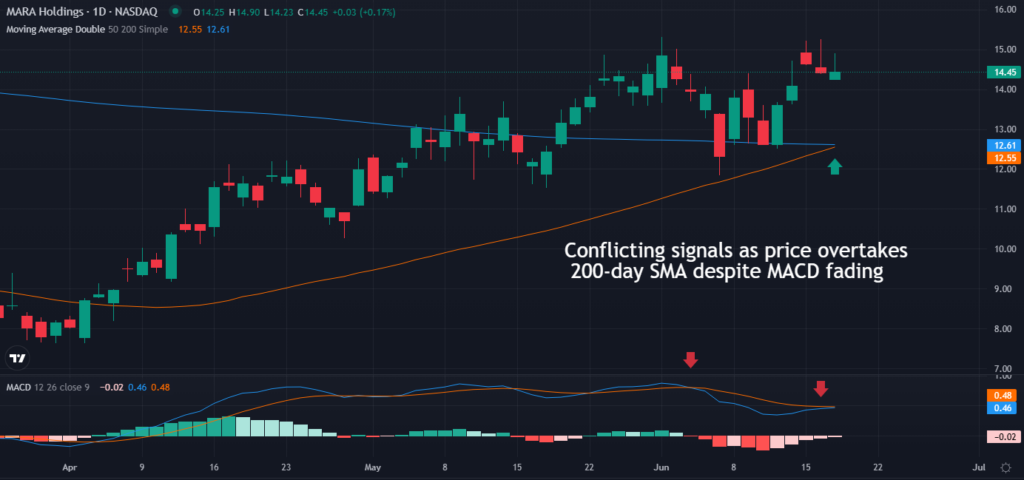
As a result, the chart is showing a power struggle between buyers and sellers. The stock has been heading nearly straight up since the end of March, and recently overtook the 200-day moving average for the first time this year. But the MACD shows momentum is weakening, and if the company's pivot stumbles, the share price is likely to stumble even harder.
Login to comment