The world’s largest IPO in history, Space Exploration Technologies Corp. (NASDAQ:SPCX), represents a new era for the US space economy. In contrast, the listing has exposed how far Europe lags in the race to commercialize the orbital economy.
Europe trails China and the US in public spending and private investment, as well as satellite launches. The European space economy reported only seven orbital launches in 2025. In comparison, the US and China conducted 180 and 93 launches, respectively, in 2025.
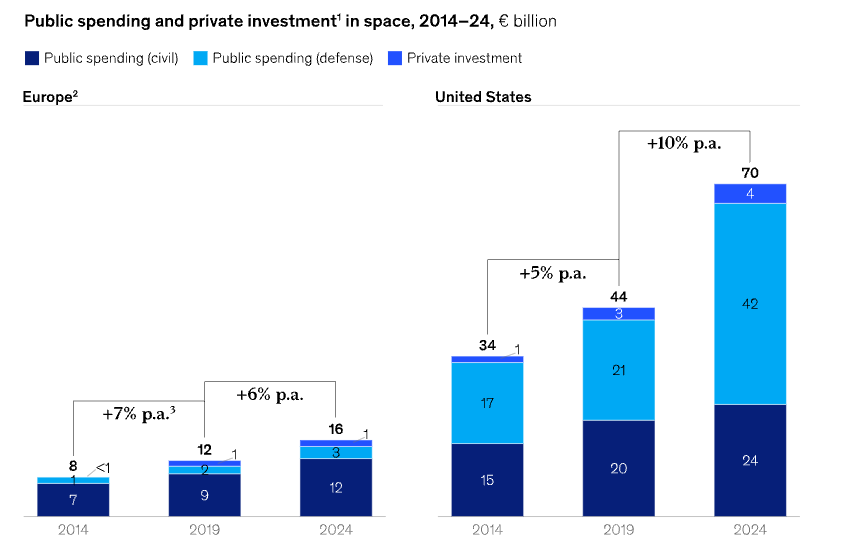
The EU has hobbled its competitiveness in frontier technology, such as AI, robotics, space and automation, with bureaucracy, over-regulation, and uncompetitive power prices. These have allowed China and the US to scale more quickly in deep tech.
"Over the years, laws and regulations have accreted and bureaucracy has expanded," Martin Halliwell, former CTO of Luxembourg-based SES SA., one of Europe’s largest satellite operators, wrote for The European in December.
"The bodies that coordinate policy, disperse funds to agencies, and allocate those funds to programs in individual countries aren’t able to support European space in the way that they must," he said. "Europe must set aside politics, cut red tape, relax rules, bring down obstacles, and simplify the complex institutional framework."
Fragmented Space Spending
Europe, however, hasn’t taken steps to reduce these obstacles, making it a less attractive destination for venture capital. Europe’s fragmented public funding and complex institutional framework hamper innovation and slow competitiveness.
For the European Space Policy Institute (ESPI), Europe’s space sector fragmentation has some benefits. "Multiple national space hubs breed resilience," ESPI researchers said.
Attracting competitiveness isn’t one of them. The US dominated investment in the space economy last year with $7.3 billion, or about 60% of global funding of $12.4 billion. Launch services and defense-related programs, such as the Pentagon’s Golden Dome initiative, drove the investments.
In comparison, European space tech investments remain marginal, increasing to more than $1.37 billion from $570 million during the same period. The number of deals has more than tripled between 2017 and 2024.
"Subscale private investment, focused mostly on early-stage deals, has prevented European space companies from achieving the scale needed globally," McKinsey & Co. said in November. "Acting today is imperative to sustain the European space industry’s long-term prospects."
SpaceX May Lift Europe VC Deal
McKinsey warned about underinvesting in Europe’s space ecosystem. It "has the potential to affect the long-term development of numerous civil and defense markets that rely on space data and services."
The SpaceX IPO may lead to a significant increase in VC appetite for space tech globally after its valuation rose on June 12 to $75 billion.
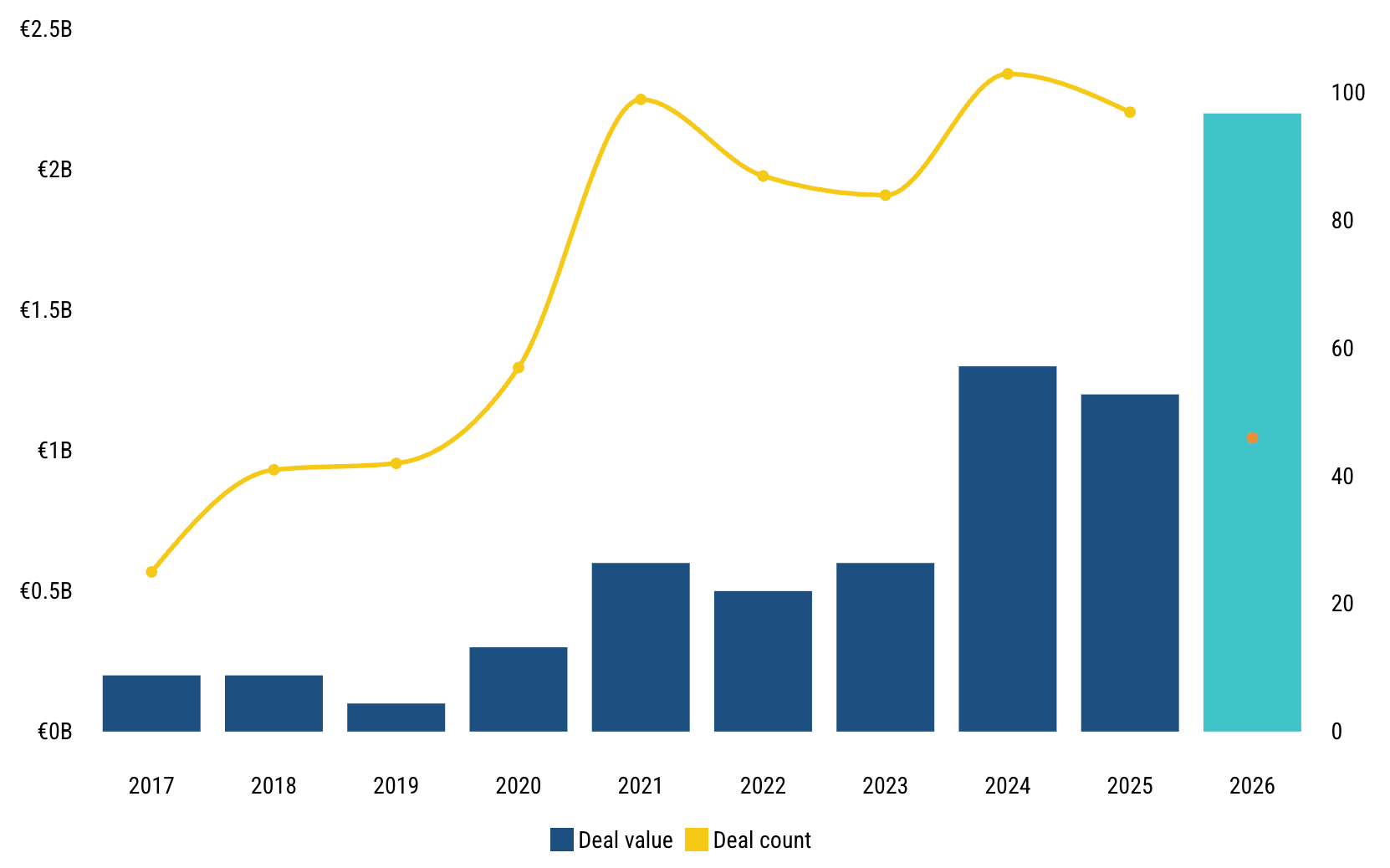
"How much will this IPO validate space as a vertical for other investors?" Sven Meyer-Brunswick, Principal at Munich-based Alpine Space Ventures, asked. "I do think there will be investors seeking the next SpaceX."
For Thomas Oehl of Vsquared Ventures, private money is going to want to invest in the next SpaceX. There are "great potential winners in the US, but Europe also has global leaders," he said.
European Space Stocks Rally
European space and satellite rallied in the wake of the SpaceX share sale. French satellite operator Eutelsat Communications (EPA: ETL) jumped as much as 41% in a single week from June 9-13.
European space stocks have outperformed the broader market year-to-date, driven by excitement surrounding the SpaceX IPO. Shares in Italy’s Avio, Germany’s OHB and Luxembourg-based SES all gained. Switzerland-based STMicroelectronics (NYSE:STM) was the standout, nearly tripling in value since January.
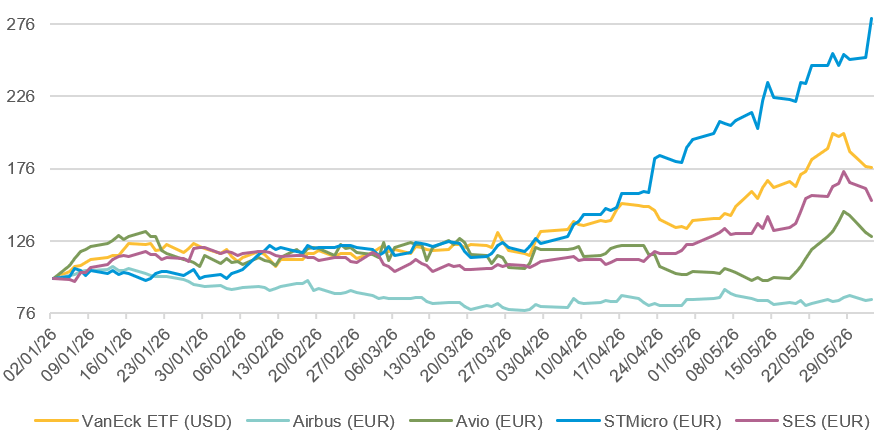
STMicroelectronics, supplier of components for low-earth-orbit (LEO) satellite constellations, offers European investors rare direct exposure to the SpaceX ecosystem. Its LEO revenue is forecast to approach $1 billion in 2026, up from $600 million last year.
Oehl said the IPO would reshape how space should be valued. "People are finally starting to believe in space," he said, adding that "founders are thinking bigger."
Europe Lacks Orbital Roadmap
Once the SpaceX IPO distraction fades, Europe will struggle to keep pace with the US and China in the space economy. No European company or government organization has anything resembling SpaceX’s orbital AI-driven roadmap.
UK-based NewStreet Research has estimated that SpaceX has at least a ten-year lead in launch capability. The company will control as much as 95% of global launch capacity through the end of the decade.
European private sector and public sector investment will struggle to close that gap. The European Space Agency (ESA) required a $410 million annual subsidy in 2024 just to keep Ariane 6 pricing viable.
"SpaceX is such a unique story," Giuseppe Borghi, head of ESA’s Φ-lab Division, said at the SmallSat Europe conference on May 26th. "It’s so dominant in the market, it’s difficult to extrapolate what’s going to happen there."
ESPI published a note calling the listing Europe’s "second chance" to scale its ambitions. On whether the IPO would catalyze European interest, Borghi had his doubts.
Europe Questions US Launch Reliance
There is also a geopolitical dynamic that frames the European space question. ESA’s "Strategy 2040" has raised questions about whether Europe can rely on access to US launch and data infrastructure as a given.
"Some governments, if they perceive the US as an unreliable partner, might try to diversify the risk," João Falcão Serra, lead on Industry & Finance of the ESPI, said. "Their willingness to work with SpaceX will not change based on whether they are public or not."
For Halliwell, Europe needs to emulate the US to develop its space industry.
"Largely freed from red tape and regulatory hurdles, a sufficiently creative and ambitious entrepreneur can have an idea and make it a reality without hindrance," he said. "That just isn’t possible in Europe."
Disclaimer: Any opinions expressed in this article are not to be considered investment advice and are solely those of the authors. European Capital Insights is not responsible for any financial decisions made based on the contents of this article. Readers may use this article for information and educational purposes only.
Benzinga Disclaimer: This article is from an unpaid external contributor. It does not represent Benzinga’s reporting and has not been edited for content or accuracy.
Login to comment