Diversification came at a cost for much of the AI-driven bull market. Investors who ventured beyond the S&P 500’s mega-cap leaders routinely lagged as the Magnificent Seven grew to account for roughly one-third of the benchmark. This year, however, that trade has reversed, and diversified equity ETFs are finally reaping the benefits.
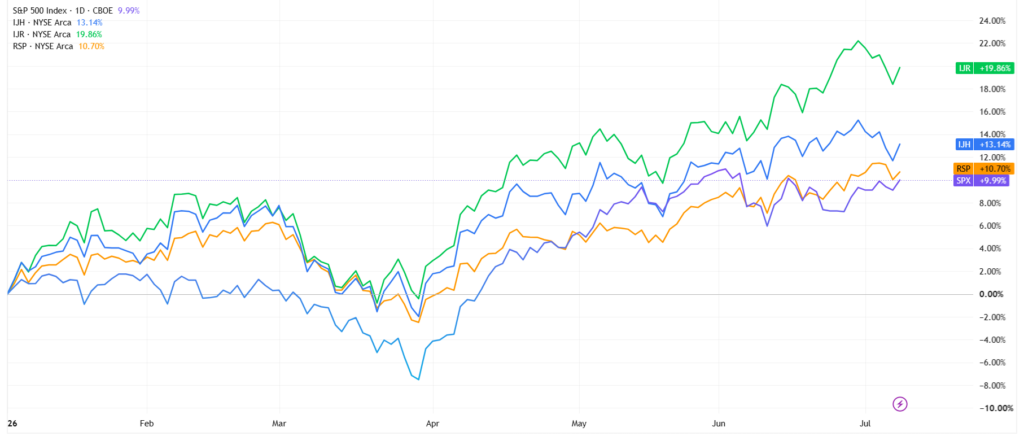
Through July 9, the S&P 500 has gained 10%, but five of the Magnificent Seven, Nvidia Corp (NASDAQ:NVDA), Microsoft Corp (NASDAQ:MSFT), Amazon.com, Inc (NASDAQ:AMZN), Meta Platforms, Inc (NASDAQ:META) and Tesla, Inc (NASDAQ:TSLA),are trailing the benchmark, with three posting negative returns. The shift has created a rare opening for equal-weight, mid-cap and small-cap ETFs that had struggled during the mega-cap rally.

Diversification Starts Paying Off
The Invesco S&P 500 Equal Weight ETF (ARCA: RSP) has returned 11% year-to-date. It outperformed the broader index by 1 percentage points. The gains are even stronger further down the market-cap spectrum.
The iShares Core S&P Mid-Cap ETF (NYSE:IJH) is up 13.4%, while the iShares Core S&P Small-Cap ETF (NYSE:IJR) has surged 20%.
The outperformance reflects a broader change in market leadership. Rather than being driven by a handful of trillion-dollar technology companies, gains have spread across financials, industrials, regional banks and smaller companies. That has reduced the market’s dependence on mega-cap tech and rewarded strategies with more balanced exposure.
Investors Broaden Exposure
Performance is beginning to be reflected in investor allocations.
According to FactSet, U.S.-listed ETFs have attracted more than $1 trillion in net inflows during the first half of 2026, the strongest first-half total on record. Equity ETFs accounted for roughly 73% of June’s net inflows, with investors increasingly allocating to size, style and sector strategies alongside traditional broad-market funds.
While S&P 500 ETFs continue to dominate asset gathering, FactSet noted that inflows are becoming more diversified across equity categories rather than being concentrated solely in capitalization-weighted index products.
State Street Investment Management’s latest ETF Flow Report tells a similar story. U.S. equity ETFs have gathered approximately $441 billion year to date, while international equity ETFs have attracted another $228 billion, highlighting growing investor demand for broader equity exposure instead of relying exclusively on the largest U.S. technology names.
Equal-Weight ETFs Have The Upper Hand
Equal-weight strategies are designed to reduce concentration risk by assigning each constituent the same weight regardless of market capitalization.
That structure proved to be a headwind when the Magnificent Seven dominated index returns between 2023 and 2025. But with several of those stocks underperforming this year, the same design has become an advantage.
RSP benefits because strong performance from industrials, financials, healthcare and consumer stocks contributes just as much to returns as gains from the largest technology companies. Similarly, IJH and IJR capture improving earnings momentum among mid- and small-cap companies that carry little weight in the S&P 500 despite posting some of the market’s strongest returns this year.
Can The Rotation Continue?
Whether diversified ETFs continue outperforming will largely depend on market breadth.
If the Magnificent Seven regain leadership, capitalization-weighted funds such as State Street SPDR S&P 500 ETF Trust (NYSE:SPY), Vanguard S&P 500 ETF (NYSE:VOO) and iShares Core S&P 500 ETF (NYSE:IVV) could once again pull ahead. But if earnings growth continues to broaden across sectors and company sizes, 2026 could mark an important turning point for ETF investors.
After several years in which concentration was rewarded, equal-weight, mid-cap and small-cap ETFs are demonstrating that diversification can once again be a source of outperformance rather than a drag on returns.
Photo: Shutterstock
Login to comment