Oil stocks are pricing in another supply shock.
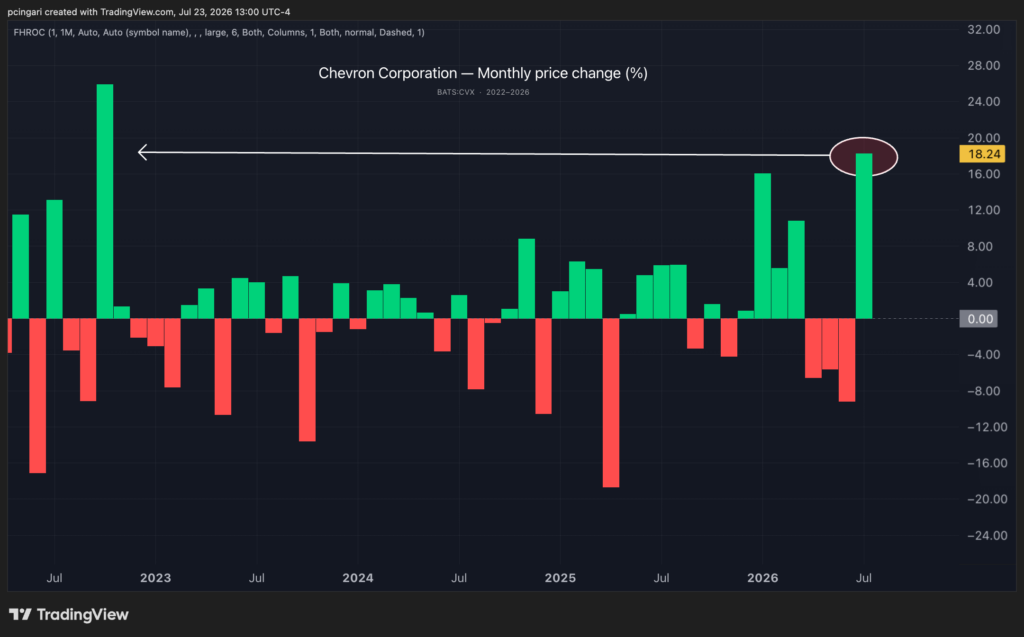
Chevron Corp. (NYSE:CVX) is on track for its strongest monthly performance since October 2022 as crude prices surged amid escalating tensions in the Middle East.
The integrated oil major has climbed more than 18% in July. Peer Exxon Mobil Corp. (NYSE:XOM) rose 15% over the same window.
Yet beneath the surface of the Middle East-driven rally, another force is quietly pointing in the opposite direction.
That force is China.
The world’s largest crude importer has suddenly slashed oil purchases to levels not seen in nearly a decade, raising a difficult question for investors: once the geopolitical premium fades, will demand be strong enough to keep crude elevated?
The World’s Biggest Oil Buyer Just Hit the Brakes
According to Jeffrey J. Roach, chief economist at LPL Financial, China is no longer providing the demand support that oil producers were counting on.
“The sharp decline in China’s crude oil imports is potentially more bearish than bullish for the global oil market, at least in the near term,” Roach said in a recent note.
China’s June crude imports fell to just 29.27 million metric tons, or 7.12 million barrels per day, according to Chinese customs data cited by Reuters.
That marked a 41.3% decline from a year earlier, another 12% drop from May, and the weakest daily import level since October 2016.
For a country that has been responsible for a large share of incremental global oil demand over the past two decades, the decline is difficult to ignore.
Roach believes investors may be underestimating what those numbers imply.
“China is the world’s largest crude importer, so the big drop in recent months signals that one of the most important sources of global oil demand is not providing the support many producers were hoping for,” he added.
China’s refinery utilization rate dropped to 57.72% in June, down 13.09 percentage points from a year earlier, suggesting refiners deliberately reduced crude purchases instead of merely struggling with shipping disruptions.
Imports from the Middle East also fell to a 10-year low, while Iranian crude purchases declined about 40% from May to below 800,000 barrels per day.
Why This Matters More Than the Middle East
The current rally in crude has been built almost entirely on geopolitical risk.
Markets have focused on potential supply disruptions across the Persian Gulf, assigning a premium to Brent and WTI prices.
But demand ultimately determines whether higher prices can be sustained.
Roach warned that weakening Chinese demand is colliding with rising global supply.
“Weaker Chinese imports arrive at an awkward time for producers. OPEC+ has been gradually restoring production, and non-OPEC supply growth remains relatively healthy,” he said.
If those trends continue, he believes the balance could quickly swing back toward excess supply.
That outlook aligns with the latest forecast from the U.S. Energy Information Administration.
The agency expects oil markets to remain relatively tight through much of the third quarter because of recent geopolitical disruptions. After that adjustment period, however, it forecasts global markets returning to the oversupply conditions that existed before the conflict as production growth outpaces demand.
The Investment Question for Oil Stocks
For Chevron and Exxon investors, the key question is not whether crude prices can remain elevated for another few weeks.
It is whether today’s geopolitical premium can survive a world in which the largest oil consumer is buying dramatically less crude while OPEC+ continues reopening the taps.
The oil rally has been driven by supply fears. Its next move could be determined by demand.
Chevron reports second-quarter results on July 31.
Image: Shutterstock
Login to comment