The viral Roundhill Memory ETF (CBOE: DRAM) has rebounded sharply and entered a local bull market as most of its holdings recover. The ETF has surged nearly 30% from its July low, and the rally could have further room to run as a rare inverted head-and-shoulders pattern takes shape.
DRAM ETF Has Rebounded as Investors Buy Memory Stocks Dip
There are signs that investors are buying the dip in memory stocks following the substantial retreat that happened in July.
South Korea’s SK Hynix has jumped to 1.645 million, up by 32% from its lowest level in July. Samsung Electronics, Micron (NASDAQ:MU), Sandisk (NASDAQ:SNDK), Western Digital (NASDAQ:WDC), and Kioxia have all jumped by double digits from their July lows.
These gains came as all these companies reported strong financial results, demonstrating strong demand for memory products. Additionally, big-tech companies like Microsoft, Amazon, and Alphabet released strong financial results and hinted that their robust spending will continue.
Most importantly, the rebound happened after Situational Awareness, a hedge fund by Leopold Aschenbrenner, sold its positions to Citadel.
Recent data shows that investors are still allocating cash to the DRAM ETF. ETF Db data shows that it added $3.9 billion in the last 30 days, bringing its cumulative inflows to $26 billion. This surge makes it one of the most successful ETF launches ever.
DRAM Has Formed an Inverted Head-and-Shoulders Pattern
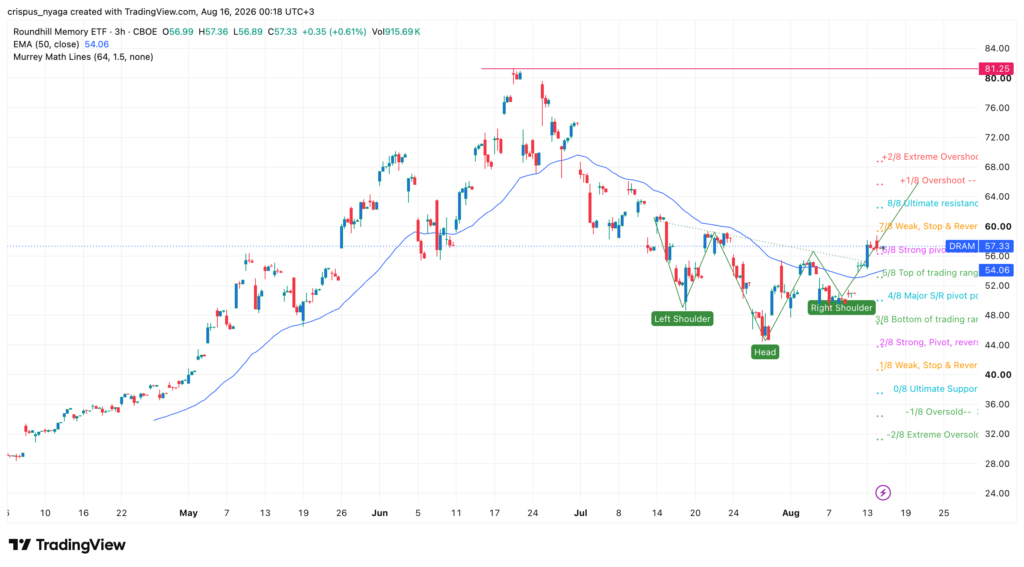
Technicals suggest that the DRAM ETF has more room to go in the coming days. It has formed an inverted head-and-shoulders pattern, a common bullish reversal pattern in technical analysis. It is about to move above the neckline.
Additionally, the stock has moved above the strong, pivot point of the Murrey Math Lines tool. It has also jumped above the 50-period moving average, a sign that bulls remain in control.
Therefore, the most likely forecast is that it continues rising as bulls target the all-time high of $81.25.
The risk, however, is that the ETF is highly concentrated, with Micron, Samsung Electronics, and SK Hynix accounting for 71.2% of the fund. This concentration presents a risk in case one of these firms face some headwinds.
The other risk is that these firms are all in the same industry. In the future, it will be at risk if the industry goes through a major downturn.
Image: Shutterstock
Login to comment