The Future Fund Managing Partner Gary Black said he has always believed Tesla Inc. (NASDAQ:TSLA) would “solve for unsupervised autonomy” with its Cybercab launch and flagged rising competition and stretched valuation, days after calling the Cybercab event “largely a bust.”
Rivals Close In On 1 Million Weekly Rides
In a Saturday post on X, Black said Alphabet Inc. (NASDAQ:GOOG) (NASDAQ:GOOGL), Baidu Inc. (NASDAQ:BIDU), Pony.ai Inc. (NASDAQ:PONY), WeRide Inc. (NASDAQ:WRD) and Amazon.com Inc.‘s (NASDAQ:AMZN) ZOOX now combine for more than 1 million weekly paid unsupervised autonomous rides without safety monitors. “A handful of others would also achieve unsupervised autonomy within 18-24 months,” Black said, adding that his previous prediction “looks accurate.”
He expects “self-driving” to become the preferred option on Uber Technologies Inc. (NYSE:UBER) and rival ride-hailing apps as more providers enter the space.
The competitive threat isn’t new. In late August, Black said Wall Street already assumes autonomy will “quickly become a commodity” once rivals catch up, rather than remain a Tesla-exclusive edge. At the time, Alphabet’s Waymo led the market with more than 500,000 weekly autonomous rides, well ahead of Tesla and Amazon-backed Zoox.
Valuation Remains the Real Sticking Point
Despite praising Tesla’s technology, Black’s caution centers on price, not performance.
Tesla closed Friday with a 2026 price-to-earnings ratio of 213 times and a 2027 P/E ratio of 158 times. Based on Wall Street’s forecast of 35% long-term earnings growth, Black calculated that this translates to PEG ratios of 6.3 times and 4.4 times, respectively. The PEG ratio compares a company’s valuation with its expected growth.
By comparison, the average “Mag 8” stock, excluding Tesla, trades at a PEG ratio of 2.7 times, he said. This suggests that Tesla’s premium is unusually high compared with its peers. That gap, Black noted, helps explain Tesla’s underperformance versus the Nasdaq 100 and S&P 500 this year and over the past one, three and five years.
Three Questions That Will Decide Tesla’s Stock
Whether Tesla can outperform after lagging major indexes depends on three factors, Black said, how quickly Robotaxi scales into meaningful earnings, whether rivals commoditize autonomy as happened in EVs from 2021-2023, and Robotaxi’s safety profile as it expands beyond geofenced Austin to other U.S. cities, Europe and Asia.
In the same post, Black said he’d rather see those three questions answered than face criticism from Tesla bulls. “Let’s move the discussion forward,” he said.
Earlier, after CEO Elon Musk touted the Cybercab’s rare-earth-free motor as a major engineering feat, calling it “extremely hard to achieve,” Black said key deployment details, including planned vehicle numbers, went unanswered at the event.
The safety concerns Black raised are already being put to the test. The National Highway Traffic Safety Administration has opened an audit inquiry into Tesla’s certification that the Cybercab meets federal safety standards, citing the vehicle’s lack of a steering wheel, pedals and mirrors.
Trading Metrics
Tesla has a market capitalization of $1.39 trillion, a 52-week high of $498.83 and a 52-week low of $297.38.
The large-cap automotive stock is down 21.27% year-to-date.
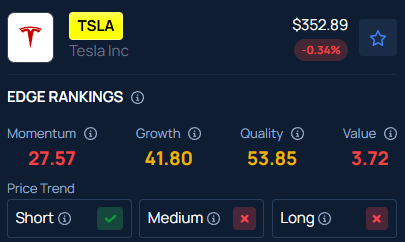
Benzinga’s Edge Stock Rankings indicate that Tesla stock is showing short-term gains, while its medium- and long-term trends remain negative.
Disclaimer: This content was partially produced with the help of AI tools and was reviewed and published by Benzinga editors.
Photo courtesy: Rokas Tenys on Shutterstock.com
Login to comment