Brent crude rose above $100 per barrel Wednesday for the first time since July as attacks on tankers and energy infrastructure intensified across the Middle East. West Texas Intermediate, the U.S. benchmark, advanced toward $95.
The U.S. military sank four Iranian tankers in the Gulf of Oman, with a fifth destroyed near Kharg Island on Tuesday, after Tehran attempted to strike American warships.
Iran-backed Houthi militants separately claimed attacks on Saudi Aramco’s 400,000-barrel-a-day Jazan refinery.
Oil back at $100 makes the winners easy to name. Oil producers and refiners are the immediate beneficiaries.
But the more interesting story lies among the losers.
Energy Stocks Turn Higher Oil Into Cash
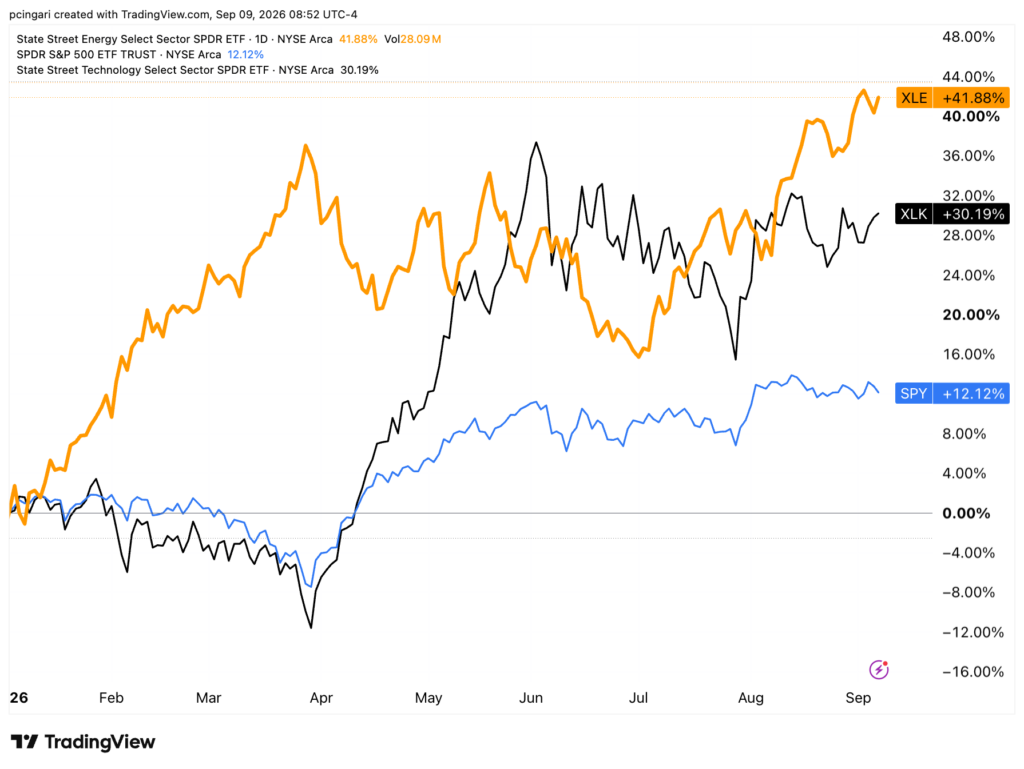
The State Street Energy Select Sector SPDR ETF (NYSE:XLE) closed Tuesday at $64.77, less than a dollar below its 52-week high. It added another 1.8% before Wednesday’s opening bell.
The fund gained 7.4% in August, leading all 11 Select Sector SPDR funds.
U.S. oil and gas stocks have risen more than 40% since the beginning of 2026.
That easily exceeds the roughly 12% gain for the SPDR S&P 500 ETF Trust (NYSE:SPY) and is also above the Technology Select Sector SPDR ETF (NYSE:XLK)‘s 30% surge.
Exxon Mobil Corp. (NYSE:XOM) and Chevron Corp. (NYSE:CVX), together are roughly 36% of the XLE fund.
Refiners buy crude, turn it into diesel and jet fuel, and keep the margin. Their profitability depends on the difference between crude costs and the prices received for those fuels, known as the crack spread.
That spread widens when fuel is scarcer than oil, which is exactly what’s happening here. Experts predict global diesel supply to stay tight through winter on a lack of spare refining capacity.
VanEck Oil Refiners ETF (NYSE:CRAK) closed at a record $64.79 on Tuesday, up 1.89%, and is up roughly 66% year to date.
Its three largest US holdings are Marathon Petroleum Corp. (NYSE:MPC) at 8.90%, Valero Energy Corp. (NYSE:VLO) at 7.57% and Phillips 66 (NYSE:PSX) at 6.91%.
All three hit fresh 52-week highs last week. Marathon has rallied 133% year-to-date.

Airlines Face An Expensive Margin Squeeze
For airlines, $100 oil works in the opposite direction.
The U.S. Global Jets ETF (NYSE:JETS) slipped in Wednesday’s premarket session after losing more than 13% over the previous month.
Over that period, Delta Air Lines Inc. (NYSE:DAL) fell 13.9%, while United Airlines Holdings Inc. (NASDAQ:UAL) declined 16.8%.
Jet fuel represents roughly 25%–30% of operating expenses for many airlines, according to the International Air Transport Association. That makes it one of the industry’s highest and most volatile costs.
Airlines can eventually raise ticket prices. The problem is timing.
Fuel costs rise immediately, while higher fares can weaken demand or take months to offset the expense. Some carriers use hedges, but coverage varies widely and offers only temporary protection.
That creates a direct squeeze on margins, particularly if crude persistently remains above $100.

The Rate Channel: Real Estate And, Yes, Gold Miners
Expensive oil feeds inflation, and inflation feeds a more aggressive Federal Reserve under Chair Kevin Warsh, who has already signaled the need to tackle persistent price pressures through higher interest rates.
CME FedWatch put September hike odds near 60% on Wednesday, up from roughly 40% before Warsh’s Jackson Hole speech, while the 10-year Treasury yield rose to about 4.78%, its highest since early 2025.
Higher yields are a direct tax on State Street Real Estate Select Sector SPDR ETF (NYSE:XLRE), by making bonds more competitive with property income while increasing borrowing and refinancing costs.
They can also pressure gold.
Bullion pays no interest. When expectations for higher interest rates surge, holding gold becomes less attractive relative to interest-bearing assets. A stronger dollar can add another headwind.
A stronger dollar can add another headwind.
That relationship extends to the VanEck Gold Miners ETF (NYSE:GDX) and Newmont Corp. (NYSE:NEM). Mining stocks often amplify bullion movements because their profits depend on the difference between gold prices and production costs.
This is the hidden risk inside the $100 oil trade.
Image: Shutterstock
Login to comment