The 10-year and 30-year Treasury bond yields climbed to their highest levels since 2002 on Thursday, and Clocktower Group market strategist Eric Wallerstein warns that the bond market is a bigger threat than artificial intelligence risk years down the line.
A Bigger Threat Than AI
Wallerstein, in a post on X, said worries about AI killing humanity in 10 years won’t matter, since “the bond market is going to kill us next week.”
Veteran investor Peter Schiff noted that the national debt was just $6 trillion back in 2002, and with the 10-year Treasury yield at 5.33%, it would have cost $319.8 billion annually.
On today’s more than $40.1 trillion debt, he said, it would cost “$2.14 trillion annually — more than Social Security.”
The IMF’s Unusual Reassurance
Economist Mohamed El-Erian said the IMF’s decision to issue a statement reassuring the public that bond markets are in order was unusual and risked raising more questions than it answered.
The comment came after IMF Communications Director Julie Kozack told reporters Thursday that bond markets globally “are continuing to function in an orderly manner.”
A Supply-Demand Imbalance, Not Just Fed Policy
El-Erian also added that comments from Federal Reserve officials have struck a hawkish tone, though not as aggressive as what markets are currently pricing in.
He pointed instead to a widening gap between rising Treasury supply and falling demand from traditional long-term buyers, saying the recent yield spike has overshot that imbalance, a dynamic he linked to hedge funds playing a growing role in the market.
CNBC’s Jim Cramer asked whether a “bond short squeeze” could be starting, citing Fed Vice Chair Philip Jefferson‘s comments that he and his colleagues “will need to come to our own judgment, which may take more time” before shifting monetary policy.
What Rising Yields Mean for Stocks
Jurrien Timmer, Director of global macro at Fidelity Investments, said rising yields typically pressure stock valuations, but strong earnings growth could soften the blow.
He noted that if the 10-year yield reaches 6%, a Fed valuation model suggests stocks should be priced at 16 times earnings, down from roughly 19-20 times today, a drop that double-digit earnings growth could help offset.
At the time of writing, the 10-year Treasury yield stood at 5.252% and the 30-year at 5.629%, both at their highest levels since May and June of 2002, respectively.
Price Action: The iShares 7-10 Year Treasury Bond ETF (NASDAQ:IEF) closed 0.01% lower on Thursday at $89.30 and was up 0.01% at $89.31 in extended trading. The iShares 20+ Year Treasury Bond ETF (NASDAQ:TLT) closed 0.09% lower at $77.71 and fell 0.1% to $77.70 in after-hours.
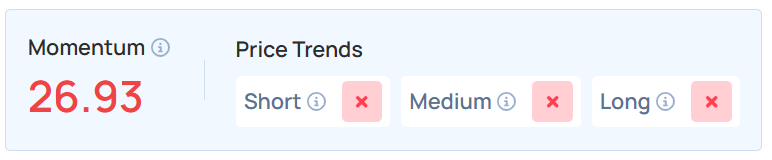
Benzinga Edge rankings indicate the 7-10 year bond ETF has a Momentum score in the 26th percentile and a negative price trend across the short, medium, and long term.
See More: Top Momentum Stocks
Disclaimer: This content was partially produced with the help of AI tools and was reviewed and published by Benzinga editors.
Image via Shutterstock/ Andrii Yalanskyi
Login to comment