On October 1, 2026, Corteva Inc. (NYSE:CTVA) completed the spin-off of its seed operating segment into Vylor Inc. (NYSE:VYLR) through a pro rata distribution to holders of record as of the close of business on September 24, 2026. Shareholders received one VYLR share for each CTVA share held. The distribution is tax-free for U.S. federal income tax purposes, except for cash in lieu of fractional shares.
Corteva keeps the Crop Protection business under the CTVA ticker. It is now a pure-play crop protection company, #4 globally, with one of the industry’s largest biologicals businesses. Vylor holds the Seed business, anchored by Pioneer, Brevant and Enlist. On FY2025 pro forma figures, Vylor is the larger and higher-margin entity, with $10.1billion revenue and $2.6 billion adjusted EBITDA (25.6% margin). Crop Protection posted $7.5 billion revenue and $1.35 billion EBITDA (18.0%).
The trading mechanics matter for the first-day numbers. Corteva determined there would be no “when-issued” trading in Vylor common stock or “ex-distribution” trading in Corteva common stock ahead of the distribution. As a result, October 1 was the first true price discovery for each standalone entity. That partly explains the volatility in the parent.
Index Reshuffle
Vylor joined the S&P 500 effective October 1, 2026, taking Corteva’s slot. Post spin, Corteva is scheduled to move to the S&P MidCap 400 effective October 6, replacing Olin Corp. (OLN). In our view, this is the most important near-term technical for CTVA. S&P 500 trackers received VYLR in the distribution and must exit their CTVA position. MidCap 400 trackers, the natural buyers, manage a much smaller asset base.
Consolidated Performance: Value Created, Mostly Before the Split
On a combined basis (1 CTVA + 1 VYLR), the holder of one pre-spin Corteva share is well ahead of the market since the October 2025 announcement:

The separation itself also added a modest amount of value. CTVA’s prior close before the spin was $77.65. Against that, the combined position closed at $78.85 on day one (+1.5%) and $79.54 on day two (+2.4%). In our view, the bulk of the re-rating happened during the 12-month run-up as investors priced in a pure-play seed franchise, and the market has broadly endorsed the break-up since completion.
Individual Performance
On the first day of regular-way trading (Oct 01, 2026), the parent lost -12.95% while the spin-off gained 0.42%.
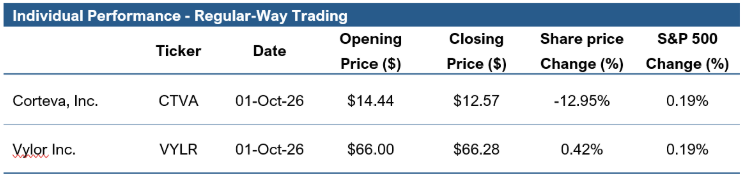
Vylor traded like a quality S&P 500 compounder from the open. Corteva traded like a classic orphaned parent. It lost 17.5% in two sessions and now accounts for just 15% of the combined enterprise value, despite generating 32% of combined FY2027E EBITDA.
We attribute the CTVA weakness mainly to technical and positioning factors rather than fundamentals. First, the stock faces index-driven selling ahead of its S&P 500 exit. Second, its market cap dropped from more than $50 billion to about $8 billion, which pushes it out of many large-cap mandates. Third, holders who owned Corteva for the seed franchise are now exiting. The parent also retains the majority of pension, PFAS, environmental and litigation liabilities, which some investors will avoid regardless of price. That said, pension risk has been materially reduced. Corteva contributed approximately $1.46 billion to its principal U.S. plan in June and July 2026.
Valuation
We value each company on FY2027E EBITDA using the multiple its standalone peer group would support.
New Corteva: 9.0x FY2027E EBITDA. This is a premium to the crop protection peer average of 6.7x (FMC, ADAMA, Nufarm, Bayer, UPL). We believe it is justified because about two-thirds of the portfolio is differentiated or patented product, biologicals are targeted to reach $1 billion by decade-end, at least seven new active ingredients are expected over the next decade (including Haviza, with >$0.5 billion peak sales potential), and the balance sheet sits in net cash of $630M pro forma. We expect the crop protection market to return to low-single-digit growth, with Chinese active-ingredient pricing firming into late 2026 and 2027.
Vylor: 15.0x FY2027E adjusted EBITDA. This is a premium to the seed peer average of 9.3x. We believe it is warranted by scarcity value as one of very few global pure-play advanced genetics companies, adjusted EBITDA margins heading above 28%, licensing turning royalty-positive in 2026, and optionality in hybrid wheat (2027 launch), gene editing and biofuels. Bayer’s 18.6x EV/EBITDA acquisition of Monsanto remains the upper anchor.
Our View. Vylor is the higher-quality asset as it is larger, faster-growing, higher-margin and offers relatively scarce pure-play exposure. At $67.62, however, the shares already imply a valuation above our target multiple, limiting near-term upside.
New Corteva is the more compelling post-spin opportunity, in our view. The company emerges as a differentiated crop-protection franchise with a net-cash balance sheet, yet is likely to face technical selling from index and mandate related repositioning. This could create an opportunity for investors to take positions at attractive entry price.
Benzinga Disclaimer: This article is from an unpaid external contributor. It does not represent Benzinga’s reporting and has not been edited for content or accuracy.
Login to comment