For most of the AI boom, Nvidia Corp. (NASDAQ:NVDA) topped the profit table by designing the chips everyone wanted. That is, until this quarter, when Seoul, South Korea-based Samsung Electronics Co. Ltd. (OTC:SSNFL)appears to have passed it.
Samsung announced Thursday that third-quarter operating profit likely reached 107.4 trillion won, or about $80.2 billion. That’s roughly $16 billion, or about 26%, higher than Nvidia’s $63.7 billion.
Lisa Su Came To Seoul For The Scarcest Part Of The AI Chip
Advanced Micro Devices Inc. (NASDAQ:AMD) CEO Lisa Su was recently in Seoul. She wasn’t there for a tour. She came to secure memory supply for the years to come.
AMD can only ship as many AI processors as it can pair with memory.
Each accelerator needs HBM, or high-bandwidth memory, stacked right next to it to feed it data at high speed.
On Wednesday, Su met Jun Young-hyun, head of Samsung’s chip division, and Kwak Noh-jung, chief executive of SK Hynix Inc. (NASDAQ:SKHY). She said both companies remain key partners on which AMD relies heavily.
The relationship with Samsung already exists. Under a March agreement, Samsung is the primary HBM4 supplier for AMD’s MI455X accelerator.
It is also developing DDR5 memory for AMD’s next EPYC server processors and Helios systems.
Memory Was Supposed To Be The Boring Part of Tech
For decades, memory chips were the commodity corner of semiconductors: prices swung wildly, and investors paid little for profits that rarely lasted. AI has changed that. Demand for HBM, conventional DRAM, and NAND has outrun supply, pushing prices and profits up sharply.
Samsung’s revenue is expected to hit a record 195 trillion won, or about $146 billion, up roughly 127% from a year earlier. Profit has grown even faster. Samsung is now keeping about $55 of operating profit for every $100 of sales—a margin more typical of software than semiconductor factories.
Micron Technology Inc. (NASDAQ:MU) earned $44.3 billion in its most recent quarter, more than Alphabet Inc. (NASDAQ:GOOG) at $40.7 billion and Microsoft Corp. (NASDAQ:MSFT) at $40.6 billion.
SK Hynix Inc. earned $38.9 billion, ahead of Apple Inc. (NASDAQ:AAPL) at $35.7 billion.
Together, the three memory makers now generate about $163 billion in operating profit per quarter. Samsung’s new figure would also put it ahead of Saudi Arabian Oil Co., which earned $57.6 billion.
World’s Most Profitable Companies
| Rank | Company | Quarter | Quarter ended | Operating profit |
|---|---|---|---|---|
| 1 | Samsung Electronics Co. Ltd. | Third quarter 2026 (preliminary estimate) | Sept. 30, 2026 | 107.4 trillion won (about $80.2 billion)* |
| 2 | Nvidia Corp. | Fiscal second quarter 2027 | July 26, 2026 | $63.7 billion |
| 3 | Saudi Arabian Oil Co. | Second quarter 2026 | June 30, 2026 | $57.6 billion |
| 4 | Micron Technology Inc. | Fiscal fourth quarter 2026 | Sept. 3, 2026 | $43.8 billion |
| 5 | Alphabet Inc. | Second quarter 2026 | June 30, 2026 | $40.7 billion |
| 6 | Microsoft Corp. | Fiscal fourth quarter 2026 | June 30, 2026 | $40.6 billion |
| 7 | SK Hynix Inc. | Second quarter 2026 | June 30, 2026 | $38.9 billion |
| 8 | Apple Inc. | Fiscal third quarter 2026 | June 27, 2026 | $35.7 billion |
Why Samsung Shares Fell
Shares of Samsung Electronics closed 2.4% lower during the Asian session as revenue estimates slightly trailed a FactSet consensus of 206.8 trillion won. The currency also worked against it. The won has strengthened about 12% against the dollar in three months, so overseas sales convert into fewer won.
Then there is the other side of the memory boom. Higher chip prices raise phone-building costs. Samsung reportedly plans to cut fourth-quarter smartphone production by 20% to 30%.
The shares have roughly tripled over the past year. Even so, they trade more than 25% below June’s record.
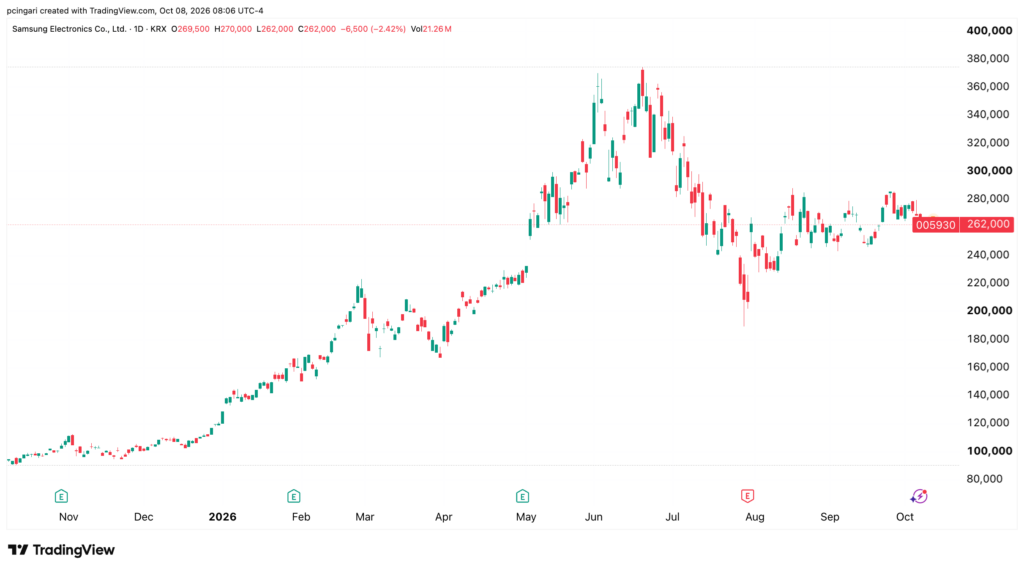
Image: Shutterstock
Login to comment